They can be a strange breed the cinema going public, some
films that are barely worth watching they will flock too and others, that are far
superior, will almost be ignored. A good example was this week’s Robert Burns
Centre Film Club screening of Abbas Kiarostami’s latest movie, the intelligent
and adult themed Like Someone in Love (2012). It attracted a very small audience
for such an interesting film, made all that more appealing by its structure.
Its has Japanese and French finance and production, an Iranian directed and
wrote it, its filmed in and around Tokyo with a Japanese cast and uses the
Japanese language. I think you will agree it’s quite an intriguing blend. The
story it self is no less fascinating, slow and precise it basically involves
three main characters.
Firstly there’s Akiko (Takanashi Rin) a college student who
moonlights as a ‘paid date’ to raise money for her education. She arrived in
Tokyo two years ago and now regrets putting out phone box flyers to advertise
her availability. She works for Hiroshi (Drenden who I last saw in Cold Fish
(2011)) who runs a high-class agency to provide escorts for men. The second
main character is Akiko’s date, Watanabe Takashi (Okuno Tadashi) an elderly
writer and translator who when she arrives after a long car journey at his book
filled flat discovers that he is more interested in having her join him for a
meal and a chat and not as the young student expected in having sex with her. The
following morning Watanabe stops at her college to allow Akiko to complete some
work before he drives her home. It’s outside the college that this kindly old
man meets the third main character in our elliptical edited film[1].
Higuchi Noriaki (Kase Ryo said to be the Japanese equivalent of Ben Whishaw) is
Akiko’s possessively jealous boyfriend who is set on marrying her. It’s at this
stage in our story that things get a little complicated when Noriaki takes
Watanabe to be Akiko’s grandfather.
 |
| The Student. |
Mr Alec Barclay
made a welcome return this week to the host chair and captivated us with
a brief outline of Kiarostami’s background before tonight’s movie began. He
even read out a previous movie ramble that mentioned two of the Iranian’s earlier
films, one of which being his collaboration with the Italian director Ermanno
Olmi and our own Ken Loach, 2005’s Tickets.
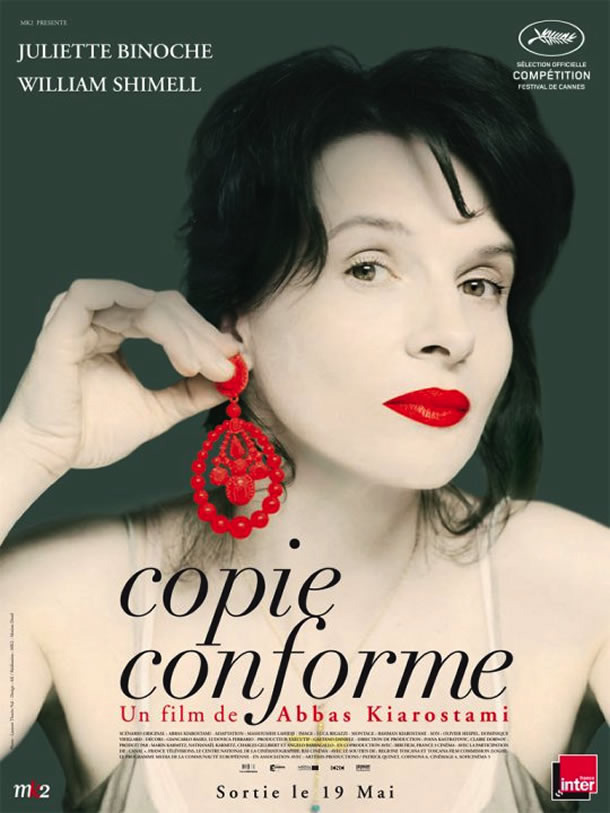
The other was his first full-length film in English Certified
Copy (2009), which I had described as ‘an
observational snapshot of human behaviour’ and to be honest that
description fitted this latest movie very well. Alec went on to tell us that
the 73-year-old Kiarostami had been active in film work since 1970 and had made
over 40 films. Greatly admired by
both Michael Haneke and Martin Scorsese he was one of the few directors
who remained in Iran after the 1979 revolution.
 |
| The Writer/Translator. |
 |
| The Mechanic. |
Abbas Kiarostami is an actors director, what I mean by that
can be seen in one of the directors trademarks: conversations in cars, no real
action in the true sense of the word, just facial movement and the way that long
and protracted conversations are spoken between the characters. Using a
minimalist approach with a simple and uncomplicated story, which has no defined
beginning or end, allowing us just a glimpse into a mere interlude in three
peoples lives. This film, for me, was a real pleasure to watch and lets hope we
have more like it rather than mainstream drivel that sometimes fills out
non-independent cinemas. I will quote something the director said during an
interview at this year Cannes Film Festival and which our host read out. ‘Happily, I can choose my viewers’ he
said ‘and I’d rather not have the
exasperated among them. Cinema seats make people lazy. They expect to be given
all the information. But for me, question marks are the punctuation of life.
When it comes to showing human beings, complexity and concealment are a crucial
part of the character. If I show more than the character shows, it doesn’t make
sense. And if the spectator doesn’t accept that, there’s not much I can do.[2]’
Very well put Mr Kiarostami.
[1] Elliptical
editing is a technique used in film editing that allows
an event's duration on-screen to be shorter than its duration in the story.