Showing posts with label Francis Ford Coppola. Show all posts

Tuesday, 12 March 2013

Bram Stoker’s Dracula.


For me the Robert Burns Centre Film Theatre is far more than just a place to watch movies, for me it’s a haven, an escape from the pressures and stresses of life. It’s a place I have fallen in love with over the years, where you meet friend’s and acquaintances and have conversations with complete strangers about film. Its run and staffed by people, some of which have worked there for over 25 years, who give the impression that would not care to work any where else, people that always make you feel at home and your visit enjoyable.

One member of the staff Ms Susan Kenny is in the last semester of her third year of an MA in Liberal Arts at the University of Glasgow on the Dumfries Campus. Susan’s options for this particular semester where either to continue with classes as usual or deliver a proposal for a placement in a working environment. She pitched a suggestion for a week long Academic Film Festival that would bring together the University and its students along with Film and RBC. Which would have the additional benefit of introducing new young people to the Film Theatre. Both of the RBCFT Film Officers were more than happy to encourage and mentor Susan.

The first film in her programme was quite a coup; she managed to land an unreleased American documentary that had never been screened without the director being present. By using her persuasive powers she not only convinced Doctor Randy Olson, a marine biologist turned filmmaker, to allow her to show his film Sizzle: A Global Warming Comedy (2008) but to take part in a Q&A via the medium of Skype. After screening mainly documentary’s to her student audience the closing event was a feature film with Doctor Ralph Jessop, one of the University of Glasgow’s emanate lecturers in Literature, leading the post-film discussion with Victorian Literature, Art and Philosophy students and one or two visitors.

Count Dracula and Mina Harker.
Very much based on Bram Stokers 1897 classic novel Dracula, Bram Stokers Dracula (1992) is powerfully directed by the man that gave us such near masterpieces as The Godfather Trilogy (1972-1990), The Conversation (1974) and best of all, Apocalypse Now (1979). Francis Ford Coppola and his screenplay writer James V Hart set out with the deliberate intent to make this film as close as possible to Stokers original text, going as far as including a prologue to demonstrate that Dracula was a direct descendant of Vlad the Impaler an Eastern European Prince from the House of Draculesti, also included was the novels diary and letter format which was cleverly used as a narrative device. The film also makes reference to previous movies about the vampiratic Lord of Darkness including Nosferartu: A Symphony of Horror (1922) and the Hammer Film Company’s ‘depictions into the deeper tendrils of Victorian naughtiness and gothic mischief[1]’. The film starred a rather convincing Gary Oldman as Count Dracula, Winona Ryder as Mina Harker for whom the Count has a deeply obsessive love, Anthony Hopkins plays Professor Abraham Van Helsing a character best known as a vampire hunter and the archenemy of Dracula with Keanu Reeves type cast as a pathetic Jonathan Harker.

The discussion that followed this gothic love story was slightly more academic than the normal RBC’s Film Club discussions, but was extremely interesting to this observer. They included the link between blood and menstruation, erotic sexual lovemaking and the symbolism of white wax oozing down a candle, and the fact that all the erotic sequences featured oral sex! We touched on the violation of the Christian sacrament and how the film demonstrated the liberalisation of women.  It was agreed that it was a difficult book to adapt for the screen in a way that does not loose the meaning or ‘feel’ of the original, but it was pointed out there was considerable more humour in the film than in the book.

Although the main character was obviously in contravention of normal behavioral patterns Coppola’s film encouraged the viewer to have a certain amount of sympathy for his humane interpretation of Dracula and the man’s rather unorthodox wooing of Mina Harker.  Although the colour had slightly faded the Blu-ray copy of this film sounded and looked very good.  It’s only left to thank Susan for all her hard work putting on this Film Festival and to wish her success with her Dissertation.

The book and its author.


[1] Susan Kenny 2013.

Friday, 18 November 2011

The Conversation.


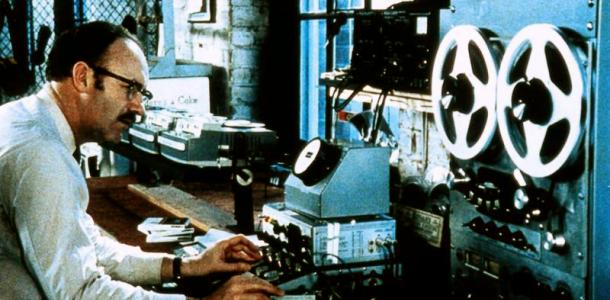
Gene Hackman as Harry Caul.
A classic film, like beauty, is in the eyes of the beholder. The Robert Burns Centre Film Theatre Film Club asked that very question of Francis Ford Coppola’s 1974 movie The Conversation. By the end of a very interesting evening hosted by Alec Barclay the consensus of the very intent audience was that it probably was, due to a variety of reasons. The reasons offered were that it is an extremely well grafted film with a very clever plot twist, some imaginative camera work, and superb direction by the man whose other work in the seventies included redefining the gangster genre with The Godfather (1972) and The Godfather Part 2 (1974) and making his Vietnam masterpiece Apocalypse Now (1979), and is probable one of the best film’s Gene Hackman made in a long and distinguished career.

John Cazale plays Harry's assistant Stan...

 Hackman plays Harry Caul a paranoid and reclusive professional surveillance officer who is instructed to spy upon a young couple. After bugging a crucial conversation, he suspects that his work may lead to their murder. Haunted by a previous tragedy in which he became implicated, he becomes obsessed with finding out the truth behind the conversation he has been asked to record. This psychological thriller, written and produced as well as directed by Coppola, was released after the Watergate scandal broke, therefore the themes of surveillance, paranoia and eavesdropping was prominent in the minds of Americans. 

Alec informed us that Coppola started work on The Conversation screenplay right after the opening of You’re a Big Boy Now in 1966, and completed a first draft in 1969. At that time there were very few original screenplays being written, and he had resolved ‘to do films only from my own original stories.’ But nobody was prepared to finance the film until Coppola had his huge success with The Godfather. The screenplay for The Conversation was partly inspired by Michelangelo Antonioni’s Blow Up, from1966.

with Cindy Williams and Frederic Forrest as the subjects of Harry Caul's surveillance....

Continuing with his introduction Alec when on to quote Coppola saying that the director had a desire to imitate and be inspired by Antonioni. “Blow Up is a very beautiful and intriguing film because it combined Antonioni’s sense of mood and personal texture and a sort of non-verbal film making with a very curious plot. I very much thought oh that’s the kind of film … these are the kinds of films I want to make where you take a theme or an idea or an area that might be something innovative. Right from the beginning I wanted to make a film about privacy; using the motif of eavesdropping and wiretapping, and centering on the personal and psychological life of the eavesdropper rather than his victims. It was to be a modern horror film, with a construction based on repetition rather than exposition, likes a piece of music. And it would expose a tacky, subterranean world of wire tappers; their vanities and ethics; the conventions that they attend; the magazines they read; and the women they value. Ultimately, I wanted the film to come to a moral and humanistic conclusion.”

and Harrison Ford as the manipulator Martin Stett.

The subject matter is still very relevant today with CCT, credit cards, and GPS systems and of course e-mails. Is anything we do today private? Coppola’s film is a very clever study of a paranoid reclusive loner who gradually realises the consequences of the job he carries out. Slightly dated but well worth seeing and yes a classic.

Thursday, 28 July 2011

Apocalypse Now


I'm in the one on the right.

I knew when I came out of the film theatre in Enfield some thirty-two years ago that I had just witnessed something really special. Since then I have watched the 1979 original and the 2000 Redux many times at home. Last night at the Robert Burns Centre Film Theatre I had the privilege to watch Francis Ford Coppola’s restored and remastered Apocalypse Now (1979) on the big screen again and after all these years it been confirmed: this is my all time favourite movie the one I hate to love!

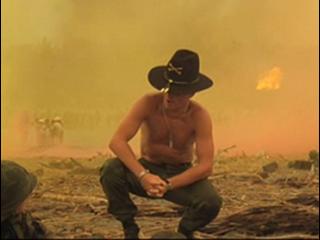
I love the smell of napalm in the morning.
The opening scene sets my adrenalin levels, we hear the helicopters reverberating against the Doors track The End; a section of the jungle is in flames, all shrouded in psychedelic smoke. We learn how a veteran officer who has been serving in Vietnam for three years and has had problems adjusting to life away from the war, Captain Benjamin Willard (Martin Sheen) is given a clandestine mission to terminate “with extreme prejudice” a Special Forces commander, Colonel Walter E. Kurtz (Marlon Brando), who has turned renegade and is running unauthorised operations out of Cambodia. Kurtz is now feared by the US military and deemed to have passed beyond what is classed as acceptable human behaviour even at this time of bloody hostilities. Willard is assigned a navy petrol boat to get him up the Mekong River that is operated by Chef (Albert Hall) and three very young, tightly wired crewmembers (Sam Bottoms, Frederic Forrest and Laurence Fishburne). As our team navigate the intricacies of war we witness Coppola’s tour de force, without doubt the greatest piece of filming ever. This is the section where crew rendezvous with Lieutenant Colonel William Kilgore (Robert Duvall) commander of the 1st Squadron 9th Air Cavalry Regiment. Kilgore, a keen surfer, discovers that one of Willard’s crewmembers is Lance B. Johnson (Bottoms); at present a Gunners Mate 3rd Class but was a professional Californian surfer. The best surf in Nam is held by the Viet Cong and the Stetson hatted Lieutenant Colonel wants to go surfing which results in the brilliantly filmed and extremely riveting gunship assault on the beach accompanied by Wagner’s Ride of the Valkyries played through the helicopters extremely loud speaker system “We use Wagner. My boys love it. It scares the hell outta' the slopes. This scene, which I have watched time and time again on DVD, ends with cinemas most famous quote “I love the smell of napalm in the morning” The petrol boat, is then dropped into the mouth of the Mekong and the journey continues, a journey that includes some really surreal moments. 


  • I'm an American! American civilian! Hi, Yanks!
     
    The further up the river they go and the nearer to Kurtz they get the darker the movie becomes including a bizarre concert which involves a group of Playboy Bunnies, put on by the United Service Organisation in front of a large group of sex starved soldiers, surrounded by inhospitable jungle and then there’s last outpost before Cambodia known as the “gates of hell”, a section of the film that resembles an acid trip! “You're in the asshole of the world, Captain!

    This is the End!!!
    The main reason this cinematic masterpiece is so significant is that Coppola manages to demonstrate equally both the horrors and the addiction of war which are recreated with stunning authenticity. It also recreates the madness that can be inflicted under such appalling conditions. Is Willard’s deteriorating sanity any better than Kurtz or even the petrol boats young crew? Its Coppola masterful direction that allows the viewer to question his or her own sanity Apocalypse Now is not a movie it’s an experience where you relish the fact you where not there or do you? “Sell the house. Sell the car. Sell the kids. Find someone else. Forget it! I'm never coming back. Forget it!