Showing posts with label Roman Polanski. Show all posts

Friday, 17 July 2015

Knife in the Water (Noz w wodzie).


Until it was destroyed during the German occupation the Polish film industry was based in Warsaw, after the war it was reinvigorated and recreated in Lodz as the National Film School attracting many aspiring young filmmakers. One of these was an ambitious young fellow called Roman Polanski who made a short film called Two Men and a Wardrobe (1958) which gained him considerable recognition, a film that was described as 'social realism', he graduated the following year.

Film making in Poland at this time was governed by the Ministry of Culture and permission had to be sought to allow Polanski to make his first feature film Knife in the Water (1962). As finance was a problem, which obviously restricted the budget, Polanski decided to use only three actors and a limited location, in this case a large lake! Originally not given permission to make the movie in his homeland, Polanski travelled to France where he made a couple of short films. A year later he was to return to Poland and resume his plan to make what would become his debut feature film and one that was first seen in the West at the 1962 Venice Film Festival, a year later it was nominated for Best Foreign Language Film at the Academy Awards - the first Polish picture to receive this kind of recognition.  The movie was co written by Polanski, Jerzy Skolimowski, who was responsible for directing Deep End in 1970, and Jakub Goldberg who after being forced to leave Poland became a lecturer at the film academy in Copenhagen.
 
Krystyna.

Andrzej.

A married couple Andrzej and Krystyna are driving to a lake to go sailing when a young man suddenly appears in the roadway thumbing a lift. After nearly running him down Andrzej invites the young man to join them on their boat. A little reluctantly, as he knows nothing about sailing, the hitchhiker accepts the offer. Rivalry and sexual tension develop as the two headstrong men vie for the attentions of Krystyna.
 
Tension rises!
Cast as Andrzej, a red bourgeoisie sports journalist, is Leon Niemczyk the only professional actor in the film, the 'young man' is played by Zygmunt Malanowicz, a product of a Polish acting school, in his debut film who went on to make a total of 30 movies. Andrzej's wife, Krystyna, is played by another debut appearance in the form of Jolanta Umecka who was discovered by the director at a public swimming pool, incidentally becoming the first Polish actress to take her clothes off on screen.  These new actors were helped by the fact that Polanski was an actor and was happy to demonstrate his requirements. Filming was a  problem because the film was shoot in very cramped conditions, it was difficult for the crew to work and they would spend a lot of the time hanging over the edge of boat. The clever use of silence and Christopher Komeda’s brilliantly composed jazzy soundtrack became a very important part of the films makeup which showed emotion in imagery rather than dialogue.


Who will Krystyna choose?

Completed Polish films were to be shown to the same Ministry politicians that granted the original permissions before it could be released. It passed this test with very little changes and went on to be the vanguard of what was recognised as the beginning of the New Polish Cinema. Although successful, Polanski who had attracted a worldwide art house following left the country of his birth because of the animosity shown by Poland's ruling elite. He went on to make three films in England including Repulsion (1965) and Cul-de-sac (1966).  


Tuesday, 23 June 2015

Cul-de-Sac.


Among distinguished company that included Joseph Losey, Francois Truffaut and Michelangelo Antonioni, Roman Polanski was a European Director that made three films in the UK during the British cinematic boom period of the 1960's. The first was the very sinister, but critically acclaimed, Repulsion (1965), which starred Catherine Deneuve who plays a repressed woman who retreats into a deranged world of her own. Because of the films success he was allowed to make the second of the three, Cul-de-Sac (1966), the third being the spoof Hammer film Dance of the Vampires (1967) which was said to be rather disappointing, although personally I have never seen it so I reserve my judgement for a latter date. Polanski did return to the UK to make a further films including the blood thirsty Macbeth in 1971. This followed the death of his then wife Sharon Tate who was murdered by the followers of Charles Manson in August 1969 along with four other people at the notorious 10050 Cielo Drive.
 
The moody Donald Pleasence plays the effeminate George....
Described as a psychological thriller, but more of a hilarious black comedy Cul-de-Sac is the story of two failed gangsters on the run after some botched skulduggery that's never explained. They end up on an Island that is cut off by the tide twice a day. Living on the island is George an effeminate ex businessman with a completely shaved head and a pair of steel rimmed classes that adds to his obvious neuroticism. Sharing the castle is his beautiful French wife Teresa. A bored, flirtatious young woman who has obviously not got a lot of time for her husband and you can't help thinking that she is quite pleased to have the company. That is until the situation deteriorates and thereafter begins a dangerous battle of nerves.
 
....with his flirty wife played by the tragic Francoise Dorleac.  
The script for this rather original movie was collaboration between the well known French born screenwriter Gerard Brach and Polanski. The title refers to the 'hole' that the two gangsters had got themselves into. It was originally planned to make the film in Eastern Europe but because of contractual details was made in Northumberland, England on Holy Island in Lindisfarne Castle. The Castle was an ideal location for this story with its coastal road that gets flooded twice a day and people can actually get stranded there. The script was adjusted to fit this setting and not staged as originally intended in a standard domestic house; incidentally furniture used in film was actually part of the Castle.
 
Gangster number 1 (Lionel Stander)
First cast was Donald Pleasence as the husband George. Pleasence was a problem with his constant mood swings and railing against the director requirements insisted on shaving his head every morning! Tests were carried out to cast Teresa; with lots of aspiring young actresses auditioning. The choice was wide, Polanski eventually settling on Catherine Deneuve sister Francoise Dorleac[1]. In the scene where Dorleac has to swim in the sea, not only could she not swim but also following the second take she nearly froze to death! Iain Quarrier a social friend of Romans from the swinging London scene who was known to indulge in a little 'dope' plays "Christopher". The film also features William Franklyn, Robert Dorning and Jacqueline Bisset. But the main problem Polanski had was casting the role of Dickey, the main gangster, eventually settling on the American ‘hard man’ Lionel Stander after seeing him on TV. But the American was not an easy man to work with, difficult, lazy and believed he knew it all, also he did not get on with Dorleac but at the time of filming he did have a heart problem that no one knew about on set! Casting the second gangster was a synch. Albi is played by Jack MacGowran who has been described by the director as ‘a dedicated actor’, a man with endless amounts of patience who nearly froze to death in one scene where the Morris Minor gets flooded and his wet suit leaked.
 
Gangster number 2 (Jack MacGowran) 
It was without doubt a very difficult shoot, lack of money and therefore time, the weather was terrible having to contend with snow, sleet, hail and heavy rain and the tides was a problem never seemingly coming at the right time of the day. Roman Polanski is well known for working his actors extremely hard and the temperamental nature of some of the cast did not help. Towards the end of the shoot the situation was becoming critical, with pressure from producers on Polanski to get the movie finished as soon as possible. I don’t believe Cul-de-Sac was really meant to be a commercial film, made more to reflect Polanski’s taste in movies with an emphasis on atmosphere and character, but an original, rather enjoyable picture that does not look or feel like any other movie thanks largely to Polanski’s direction and Gilbert Taylor’s black and white cinematography.


[1] Dorleac was killed in a car accident on the 26th June 1967.

Tuesday, 2 December 2014

Venus in Furs


We learn quite early on in Roman Polanski’s latest movie that its not based on the Lou Reed song that was released on The Velvet Undergrounds debut album in 1967 but on the story written by Leopald von Sacher-Masoch, the great-great uncle of Marianne Faithful and the man who gave his name to the enjoyment of receiving pain. Polanski’s film Venus in Furs (2013) is based on a two-person play by David Ives, who helped Polanski adapt it for the screen, and which was originally set in modern New York City and premiered on Broadway in 2011.
 
The beautiful Wanda von Dunayev.
Set in a run down Parisian theatre, Thomas Novacheck (Mathieu Amalric who has an uncanny resemblance to the Polish auteur) has written an adaptation of Sacher-Masoch’s 1870 novelette and is alone in the theatre after a long day unsuccessfully auditioning actresses for the leading role of Wanda von Dunayev. Just as the debut director is about to leave the building for home in waltzes a dishevelled actress, Vanda Jourdain (Emmanuelle Seigner, the present wife of Roman Polanski) who begs the rather despondent director to let her read for the part. At first he refuses, suspecting that the woman is no better than the flock of hopefuls he has already seen, but she eventually persuades him.  Much to his surprise she has a complete understanding of the part she is about to play and when Thomas reads the part of Severin von Kusiemski he becomes completely obsessed, drawn into the world of masochism, furs, bondage and submission.
 
Wanda or is it Vanda asserts her every whim on Severin or is it Thomas? 

This movie is a play within a play, where we witness both life as a play, and a play-acting out life. The two actors are totally convincing in the ‘dual’ roles they perform. Except at the opening credits and at the end credits, the film is completely based within the confines of the theatre. The skill of the writing was very much appreciated by this blogger; its humour and the clever manipulating of the characters were superb. Polanski in top form, in what’s unusual for him – a grand comedy. Not to be missed.

Venus in Furs.

Tuesday, 2 April 2013

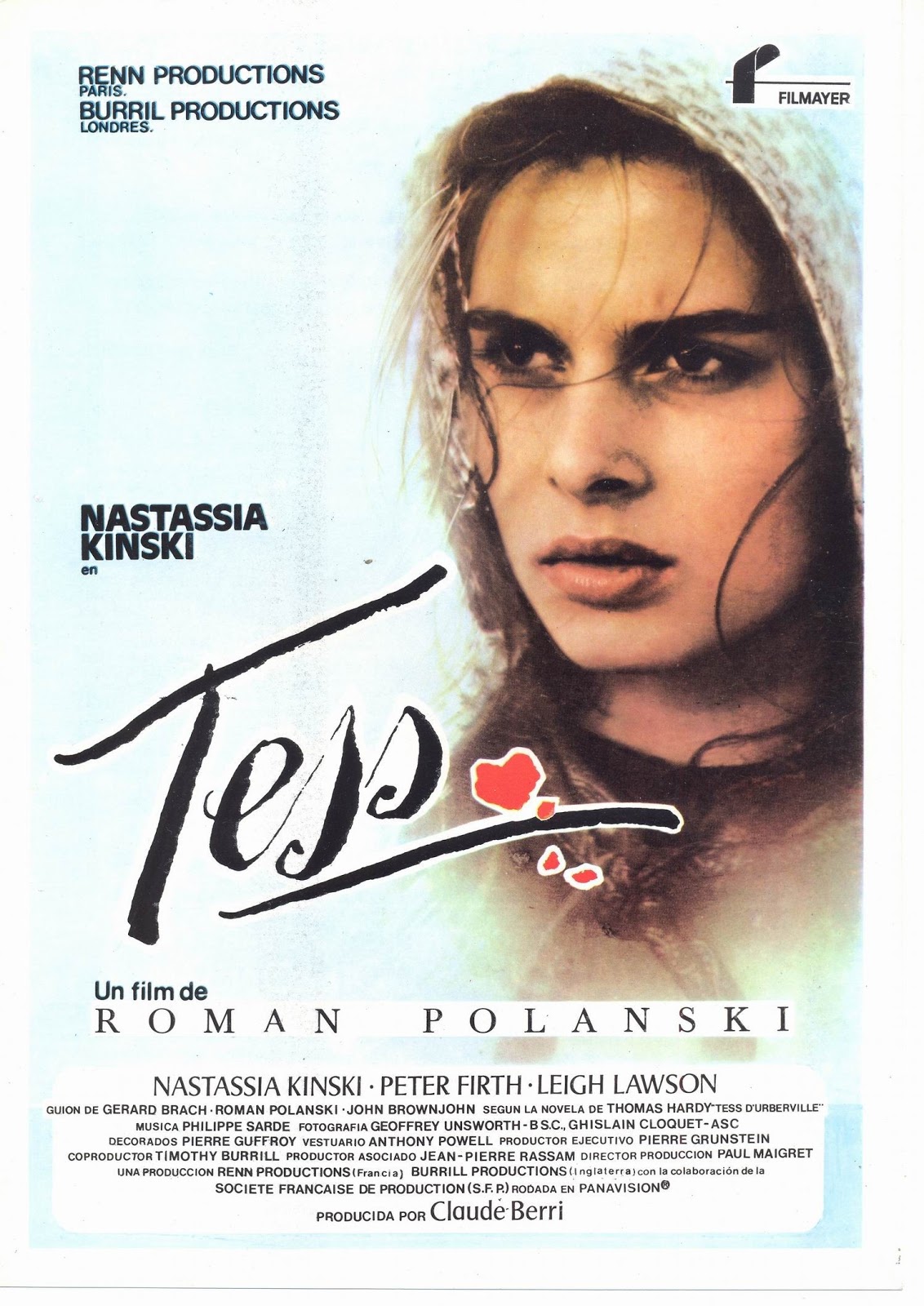
Tess.


It has been alleged that Roman Polanski made the literary adaptation of Thomas Hardy’s 1891 novel Tess of the d’Urbervilles because the last time he saw his wife Sharon Tate alive[1] she had given him a copy of Hardy’s book and told him it would make a great film. A dedication at the start of the Tess (1979) simply reads ‘to Sharon’.

Polanski was born in Paris 1933 but raised in Poland. His career has been over shadowed by accusations that he drugged and raped a 13-year-old girl, a charge he denied, entering a guilty plea for unlawful sexual intercourse with a minor instead! He fled the United States for Europe and never returned. The only Oscar he has won for Best Director was for The Pianist (2002), although he has won many film awards in Europe including Repulsion 1965, Rosemary’s Baby (1968) Chinatown (1974) The Ghost 2009 and Tess.

Set in Dorset, but actually filmed in France, Tess stars the German actress and Polanski’s partner at the time, Natassja Kinski as Tess Durbeyfield with Leigh Lawson taking on the role of Alec Stokes, master of the d’Urbervilles who seduces, rapes and impregnates the young Tess with child, which dies shortly after birth. Peter Firth, best known for his role of Sir Harry Pearce in the BBC TV series Spooks, plays Angel Clare who falls head over heels in love and marries Tess. But on their wedding night Tess reveals her inner most secrets (never a good idea at the best of times) putting the kibosh on any idea of consummating the marriage.

The unsmiling Tess is seduced by a strawberry.
The film is melodramatic and overlong, without an ounce of genuine humour (It makes you wonder if Kinski knows how to smile?). Polanski’s film is made incredibly dourer by the length of time the story takes to unfold. The film did win an Oscar for the Best Cinematography. It was shared between George Unsworth, who died during the filming, and his replacement Christain Cloguet. Not a movie I would particularly recommend, it’s a hard watch. I believe the only other non-silent film adaptation of Hardy’s story was the equally disappointing Trisna (2011) directed by Michael Winterbottom and set in 21st century Indian, it stared Freida Pinto and Riz Ahmed.


[1] Members of Charlie Manson’s family murdered her in 1969 aged 26.