Showing posts with label Martina Gedeck. Show all posts

Tuesday, 3 June 2014

The Nun.


Directed and co-written by Guillaume Nicioux from the adaptation of an anti-clerical novel written by Denis Diderot which was intended as a practical joke ‘a compilation of letters he sent to a devout fiend in the guise of a desperate nun looking to leave the sisterhood[1].
 
Mother reveals her secret to her daughter. 
The story is set in 1760's France and reveals the dehumanising effect of cloistered life on a young girl. The young girl in question is the daughter of a once rich bourgeois family; her mother (German actress Martina Gedeck) admits that Suzanne is illegitimate. Because of the family's financial problems and her mother's deep feeling of guilt Suzanne Simonin (Pauline Etienne) is committed to a nunnery, very much against her will. When the kindly but manipulating Mother Superior Madame de Moni (Francoise Lebrun) dies the replacement turns out to be sadistic and cruel, compelling Suzanne to becomes ever more rebellious and strongly resisting the rules of the convent. Sister Christine (Louise Bourgoin) inflicts the worst forms of humiliation making her wear a hair shirt, administering beatings and depriving her of food and clothing. After complaining about her treatment Suzanne is transferred to another convent, where she discovers another kind of Mother Superior (the award winning Isabelle Huppert) one who tries to instigate an inappropriate affection towards her charge.
 
Although Suzanne has a devout faith she objects to being sent away. 
The Nun (2013) tells the story of a young woman trying to resist imposed religious values, revealing, as I have said, the dehumanising effect of a cloistered life. The highlight of this female led period drama is the scene steeling, over the top performance from Ms Huppert who demands more than faith from our pretty heroine? The film attempts to deal with not only the fanaticism and power of the Catholic Church but also the restricting class structures of 18 century France. It premiered in competition at the 63rd Berlin International Film Festival and won a Best Actress Award for Pauline Etienne.

Mother Superior forces her attentions!


[1] Henry Barnes.

Wednesday, 23 October 2013

The Wall (Die Wand)


Introduced by Julie McMorran this weeks Robert Burns Centre Film Theatre Film Club showing of Die Wand (2012) is the story of a women who is forced to break with her normal life by means of an inexplicable phenomenon and live a new life in a strange and different world. 

The waiting.
Visiting a cabin in the mountains with two friends, this nameless middle aged woman along with her friends dog are left on there own when the couple go off to walk to the nearest village. Following an early night the woman awakens from a deep sleep to discover that her two friends have not returned. After breakfast she sets off to the village to find them. A short way down the road she discovers that a mysterious solid invisible barrier has sprung up cutting her off from the outside world. The story is narrated as the woman writes her 'report' on the limited amount of paper she has available. The appearance of the invisible force field is never explained but would at first appear to be an allegory for separation and the will to survive. This landlocked female has only the dog, two cats and some farm animals for company. Devoting herself to her animals especially Lynx the dog (who belongs to the director) she makes a conscious decision to survive.
 
Die Wand!
Directed and adapted from Austrian writer Marlen Haushofer’s novel of the same name by Julian Roman Polsler, a man better known for helming TV movies rather than feature films. He first read the book 25 years ago but did not gain the film rights until 18 years latter. First written in 1963 but not published until two years before her death in 1968 from bone cancer, Haushofer’s dystopian novel did not become a best seller until the 80’s some ten years after her death.
 
The 'report'.
Portraying a strong Germanic female goes back even beyond Leni Riefenstahl and Polsler successfully continues this trait by casting the powerful presence of Martina Gedeck in the role of the woman and even with no human presence to interact with, proves her worth as an actress. Her credits have included some very well known award winning German films including The Lives of Others  (2006) and The Baader Meinhof Complex (2008).

The family.
This powerful film was shot in the very photogenic Gosau region of Upper Austria over a long 14-month period by nine of Austria's most accomplished cinematographers including Martin Gschlacht (Lourdes 2010 Ravanche 2008) and Christian Berger (The White Ribbon 2009) 

 
Survival.
The discussion following the screening debated two main points, the theory about the human animal bond and how good this is for the health of the human as well as the dog, lowering blood pressure and cholesterol levels. The second point of discussion was the Film Clubs analysis of the film, which did vary. The book is said to voice the nuclear anxieties of the sixties but survival and loneliness where two of the interpretations as was the author’s metal state. Allegedly whist writing the book she was said to be dissatisfied with life and suffering from serious depression, the eminent psychiatrist Paulas Hochgatterer said that the book ‘is a precise description of clinical depression’.
 
At peace.
This minimalist film where almost nothing happens, has been accused of being a feminist statement, ‘because the fact that the characters a woman plays an important role. It’s no coincidence that all male energy is snuffed out: the dog, the man and the bull all die, while the woman, the cat and the cow survive[1] By the end of the film she has not so much become androgynous, as transcending sexual identity, is this feminism? Perhaps a little long but that does not alter the fact that this film is an exceptional piece’s of work both from the leading lady and the director. Not quite up to Tarkovsky’s masterpiece Stalker (1979) but like that film it is stark, emotionally gripping and transcends loneliness.
 
Acceptance.
The question I think the film raises is how much do we really need human contact?


[1] Julian Polsler interview with Karin Schiefer November 2011.

Monday, 10 December 2012

The Lives of Others.


After seeing Barbara (2012) at the RBC Dumfries I thought a revisit to another German film set around the same timespan would not be out of order. Although I have seen The Lives of Others (2006) quite a few times, twice at the cinema plus a couple of times on DVD I still find that viewing this award winning movie a very emotional experience.

East German secret Police surveillance operation......

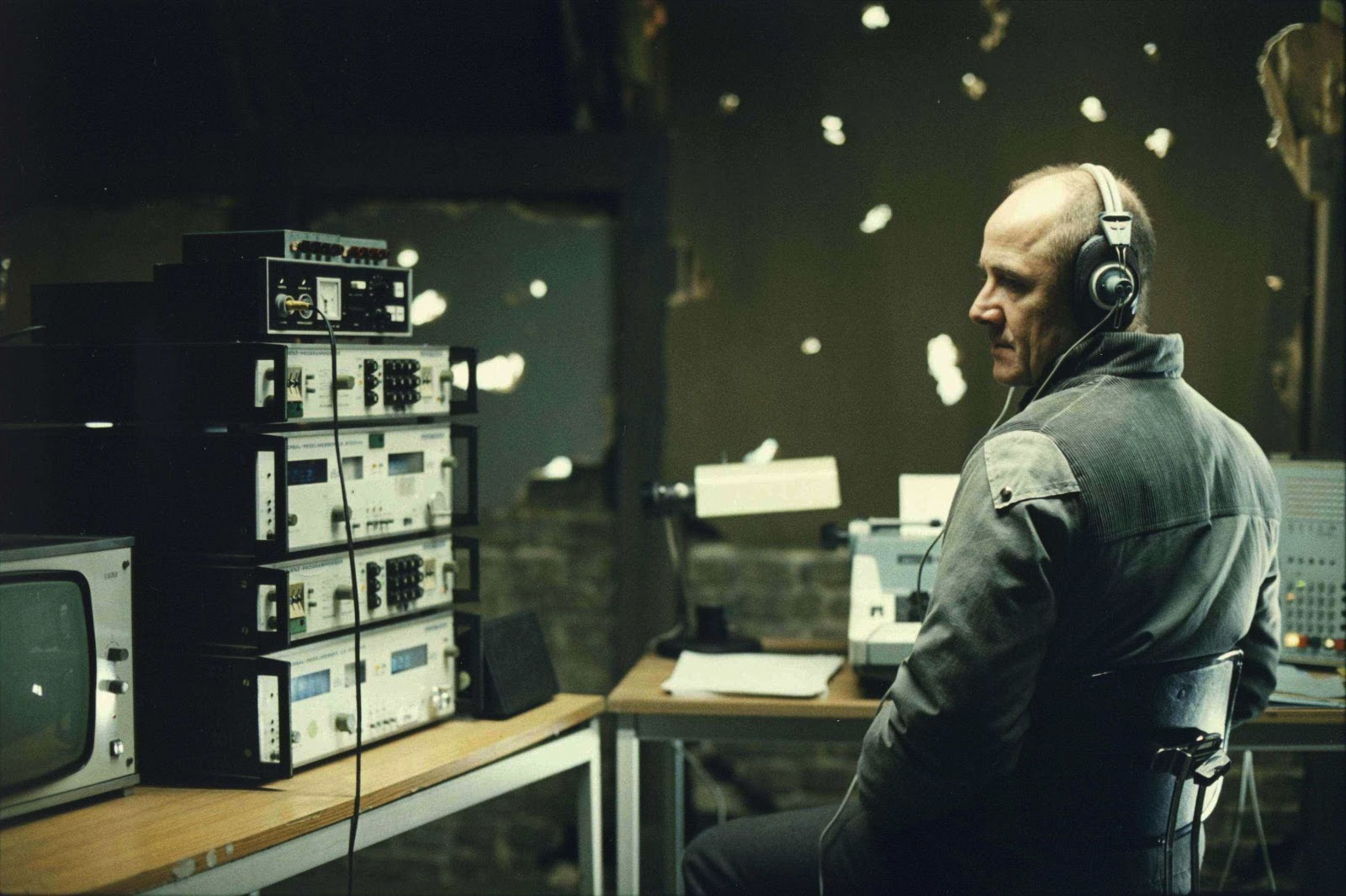
For those of you that have never seen this film, I doubt that will be many, I will give you a short synopsis. The film opens with a written statement informing us its 1984, we are in East Berlin and Glasnost is nowhere in sight. The population of the German Democratic Republic is kept under strict control by the East German Secret Police (the Stasi) Its force of 100000 employees and 200000 informers safeguard the Dictatorship of the Proletariat. Its declared goal is to know everything.  To this end Captain Gerd Wiesler (Ulrich Muhe) a hard-line Stasi officer is engaged in the surveillance of an author/playwright Georg Dreyman (Sebastian Koch) and his beautiful actress girlfriend Christa-Maria Sieland (Martina Gedeck) But unbeknown to Wiesler its not for political reasons that he has been asked to spy on the loyal socialist Dreyman but more to do with removing him on some jumped up charge so that the East German Culture Minister Bruno Hempf can have the beautiful actress Christa-Maria all to him self.  Wiesler is a sad and lonely man, with no friends and no life outside of his work so when he begins to gather information during the surveillance of the academic couple he realises that there is a life beyond his bleak existence and he begins to form a bond with two people he does not know. This in turn makes him question the morality of his job and politics.

...........Dreyman and Christa-Maria have no idea whats happening in their loft area!

The strength of this movie is in its powerful script written by the film’s director Florian Henckel von Donnersmarck (The Tourist 2011) who carried out extensive research by interviewing both the people that worked for the regime and those most effected by it. Machines and equipment that were actually used by the Secret Police along with genuine street locations, clothes and cars gave the film a great sense of authenticity. A wonderfully convincing performance from the complete cast with Ulrich Muhe’s part as Wiesler allegedly mirroring his own life! After German reunification he discovered evidence in his Stasi file that he had been under surveillance not only by four of his fellow actors but also by his wife who was registered as an ‘unofficial collaborator’ although she denied it. Muhe subsequently died of stomach cancer in 2007.  It was the Lebanese composer Gabriel Yared, who won an Oscar for Best Original Score for The English Patient (1996), who composed the haunting Sonata for a Good Man that plays such a significant part in von Donnersmarck film. Incidentally Sebastian Koch, who could not play the piano, practiced for four hours a day for six weeks so that he could actually perform this music. This is an intensely enjoyable piece of cinema that reveals the mechanism of dictatorship by showing as clearly as possible human destinies from the perspective of a man that worked for the secret police, unusually, for German film, depicting him as a human-being rather than a clog in the state wheel. 


Friday, 26 November 2010

The Baader-Meinhof Complex


The insignia of Red Army Faction showing a red star and an MP5
It wasn’t just about killing Americans, and killing pigs, at least not at first. It was about attacking the illegitimate state that these pawns served. It was about scraping the bucolic soil and exposing the fascist, Nazi-tainted bedrock that the modern West German state was propped upon. It was about war on the forces of reaction. It was about Revolution. From the introduction to Richard Huffman’s book ‘The Gun Speaks – The Baader-Meinhoff Gang at the Dawn of Terror’

After watching Carlos the Jackal (2010) I thought it was the right time to revisit The Baader Meinhof Complex (2008) it relates the story of the group that would become the most prominent revolutionary movement in post war West Germany The Red Army Faction. Based on a book of the same name by Stefan Aust the film concentrates from its beginnings in 1967, the early years of the German student movement, up to the Stammheim prison suicides in 1977. Directed by Uli Edel and starring Moritz Bleibtreu as Andreas Baader, Martina Gedeck as Ulrike Meinhoff and Johanna Wokalek as Gudrun Ensslin plus a great supporting cast that includes Alexandra Maria Lara and Bruno Ganz. This fascinating movie tells the thrilling story of a segment of German history all be it brutal and somewhat bloodthirsty. As a film it’s a great piece of action drama, as an historical record it’s fascinating and does seem to ring true, like Carlos it would appeal to anyone with the slightest interest in modern European history.