Showing posts with label UK/Ire. Show all posts

Thursday, 26 May 2016

The Lobster.


I agree with Peter Bradshaw when he writes that The Lobster (2015) “appears to run out of idea’s at its mid point”[1] It’s a film of two halves the first holds your attention but the second half can not be accused of the same.  The films turning point comes when the main character escapes the confines of the hotel and joins the loners in the woods. This dark dystopian satire is the work of Greek born Yorgos Lanthimos who has directed and produced some of the most atypical but enjoyable movies of the last few years including the chilling fairy tale Dogtooth in 2009 which deservedly won the Prix Un Certain Regard at 2009’s Cannes Film Festival, the strangely watchable Alps in 2011 and also worked as co producer on the appealing Attenberg (2010) one of Movie Rambles most blogged movies. As is quite normal with films that involve Lanthimos the synopsis makes strange reading….
 
David with the Lisping Man and the Limping Man.

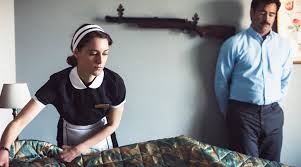
Sexual relief can only be administered by the Maid.

It’s the present, we are somewhere in a mysterious Europe country. David’s (Colin Farrell) wife has left him and we find him in a hotel where the rules state that if you don’t find a compatible ‘mate’ within 45 days you will be turned into an animal of your choice, in David’s case a lobster. David is there with his brother who has previously been turned into a dog. The Hotel Manager (Olivia Colman) sets the rules and they must be obeyed. Sexual relief by masturbation is not allowed but sexual stimulation by the hotel Maid (Ariane Labed) is. Dances are arranged so that partners can be viewed but to form a qualifying partnership with someone you must have something in common with each other. Everyone can extend their stay affording extra time to find a partner by hunting and tranquilizing escapees known as Loners who live in the nearby woods.  David decides to escape from the hotel and join the band of Loners lead by Loner Leader (Lea Seydoux). Here in the woods the rules are different. Above all they must remain single, romance and sex in any form is not allowed. Deviation from the rules is punishable by violence. 
 
Davids getting to know the Nosebleed Women....

....before joining the Loners and disobeying their rules.

You would certainly have to see the film to understand Lanthimos’s script and even then the movie probable requires more than a single viewing to fully understand the intricacies of this strangely hypnotic story.  The film has a great cast list, as well as these already mentioned it includes Rachel Weisz as the Short Sighted Woman, the lovely Jessica Barden as the Nosebleed Woman, Ben Whishaw as the Limping Man and old friend of Movie Ramble Michael Smiley as Loner Swimmer. Of all the films involving Yorgos Lanthimos that I have seen this is not his best work, interesting but not quite up there with his previous movies. It’s a real shame that the second half of the film was not as good as the first or it could have been one of his best outings.


[1] The Guardian 18th May 2015.

Monday, 14 July 2014

Jimmy’s Hall.


A painting of Jimmy Gralton.
Perhaps following the success of his latest film Ken Loach can be persuaded to rescind his claim that (2014) will be his last feature film? Along with regular’s producer Rebecca O’Brien and writer Paul Laverty Britain’s greatest living director has made a welcome follow up to his award winning homage to communism The Wind that Shakes the Barley (2006). In this Loach drew a parallel between the battle for freedom and democracy in Spain during its Civil War 1936 -1939 (see Land of Freedom 1995) and the Irish War of Independence (1919-1921), and the subsequent Civil War (1921-1922). It raised the question of what kind of Ireland was being fought for? As the director said ‘both in Spain and Ireland there were two questions. The first in Spain, was how do we beat the Fascists? And in Ireland, how do we get the imperialists out? Then the question was, if we achieve that, what kind of society could we create? If you’re risking your life for something, you want to know what you’re risking it for. It’s a very political event of real consequence[1] From James Connolly’s[2] famous 1897 essay Socialism and Nationalism. ‘If you remove the English army tomorrow and hoist the green flag over Dublin Castle, unless you organise a socialist Republic, your effects will be in vain, England will still rule you through her landlords, capitalists and commercial institutions’. Change the ‘English army’ to the Westminster government, and obviously change the flag, and Connolly’s quote could refer to Scottish independence!!
 
Persuaded by the local youngsters to rebuild the hall.
In this new piece of work Loach tackles a rather smaller part of Irish history but no less important, the story of Jimmy Gralton (Barry Ward) and his community hall in County Leitrim originally named after two of the leaders of the failed 1916 Easter Rising Padraig Pearce and James Connolly and built by Gralton in the 1920’s. Laverty’s screenplay is based on the true story of Gralton who was an Irish communist leader who travelled to America and became an US citizen in 1909 after his life was put in danger. Ten years after the end of the Irish Civil War (1922 -1923) he returns to Ireland to work on his mother’s farm following his brother’s death. Against his wishes and knowing it would open old wounds, he is persuaded by the local youngsters bored with their mundane lives to renovate and reopen the hall as a place of culture, art, sport and dancing much to the disgust of the ‘masters and pastors’ the local landowners and the Catholic Church in the form of the formidable Father Sheridan (Jim Norton) who believe that the hall will become a hotbed of socialist revolution.  Interestingly this has also been performed theatrically based on a play by Donal O’Kelly.
 
Do we stay open?
Jimmy Gralton witnessed America’s Great Depression 1923-1933 and returned to Ireland to witness its own complicated divisions not just politically but religiously. He was deported from Ireland in 1933 as an ‘undesirable alien’, without a trial, for little more than harbouring thoughts of freedom and fairness. The film makes it quite clear that below the pomp and circumstance of organised religion Christ’s teachings are nothing more than socialism under a different heading i.e. supporting the working class, the underprivileged, the sick and the old and helping others where needed, with the church originally providing education for children, way before the upper class thought it necessary to educate the ‘lower’ class. The movie does give a parallel with what is happening today between the privileged few and the rest of us, and the way ordinary people are treated by the government and their rich supporters -  landlords, capitalists and commercial institutions’. Great Britain has recently seen a million people on strike and the government’s attempt to stop the right of people to withdraw there labour brought on by the austerity measures which deliberately set out to punish ordinary people. Unbelievably we get people grizzling about their children having to miss a day at school! They should think themselves lucky to have free education! If people do not protest at times then we may not have?  Or as Ken Loach put it ‘the central message of Jimmy’s Hall is that it is vital to give space to “dissident voices” who oppose the neoliberal, free market consensus[3].
 
Barry Wood as Gralton with....

....Simone Kirby as Oonagh....

and Jim Norton as Father Sheridan.
With Loach’s realist direction, Laverty’s superbly rich writing skills and the authentic period detail, this wee drama is another great addition to Loach’s oeuvre and hopefully not his last feature film  - what would I have to look forward too, cinematically at least, very few films stir my political juices quite as much as Ken’s?


[1] Harlan Jacobson ‘On the Job’ Film Comment 2007
[2] James Connolly was one of the executed leaders of the 1916 Rising.
[3] Ken Loach speaking at the Cannes Film Festival.

Thursday, 29 May 2014

Calvary.


Killing a priest on a Sunday, that would be a good one know.” During a confessional, Sligo priest Father James is told that he will be killed on the next Sabbath, not because he is a bad priest, in fact quite the reverse, but because he is a well-respected man of God and well thought of by his congregation. He has been subjected to this death threat to atone for the sins of the Catholic Church and a paedophilic priest that was never brought to justice and has since passed away. The confessionee tells of systematic abuse where sexual acts were performed on him as a young lad over a period of many years leaving him in a disturbed state. We spend the following week in the company of Father James who knows who has threatened him, but we are left to guess which of his rather unsavoury parishioners will or will not carry out the death threat.
 
The beautiful Sligo countryside. 
We get to meet the human flotsam that are continually challenging James Lavelle’s commitment to his faith. There’s the rich local tycoon (Dylan Moran) whose wealth had not stopped his wife and children from leaving him, the cuckolded local butcher (Chris O’Dowd) whose promiscuous wife Veronica (Orla O’Rourke) seems to be up for sex with any one except her husband and her latest conquest Simon (Isaach de Blankole) an African motor mechanic and there’s a very cynical doctor (Aidan Gillen) who seems to be obsessed with suffering and we must not forget the sexually frustrated Milo (Killian Scott). As one of our audience remarked during the discussion that followed the screening, “more a whose-gonna-do-it than a whodunit.”[1] Like John Michael McDonagh’s first feature film The Guard (2011) Calvary (2014), which is the penultimate film of this seasons Robert Burns Centre Film Theatre Film Club programme, has little to do with social realism and is far darker than his debut movie and is not a comedy, black or otherwise!   
 
Some of the most tender scenes are between the priest and his daughter. 
Introduced by Julie McMorran who informed us that McDonagh, who was born in England of Irish decent, also wrote the screenplay for tonight’s film and was the brother of writer and director Martin McDonagh who was responsible for Six Shooter (2004), In Bruges (2008) and Seven Psychopaths (2012).  Both of the brothers have a slightly different approach to presenting a story, which normally allows a sense of compassion for the main protagonist and both tend to use Irish actors including Brendon Gleeson who played Donnelly in Six Shooter, Ken in In Bruges, Gerry Boyle in The Guard and Father James in John Michaels latest film.
 
Will the church come to Father James aid?
Unlike the young priest in his church Father James is not naive man but one who has lived and loved in the non-secular world. He has been an alcoholic, was widowed and has a daughter who comes to visit him from her home in London. In fact some of the most tender and emotional scenes in the film are between the priest and his daughter Fiona (Kelly Reilly) who has recently attempted suicide.  It was generally agreed by the RBCFT audience that this well written film got very much darker as the story went on and did not have the humour that the directors debut film contained. However it did set out some very interesting questions mainly involving people’s faith and their belief in a superior being. Described as a ‘terminal illness melodrama’[2] a powerful, and at times moving story, about a man who is deemed guilty by association and like Christ is punished for the sins of others.

Will it be the end for James Lavelle?


[1] Alec Barclay
[2] Connor McMorran

Thursday, 27 June 2013

Hunger.


Bobby Sands was only 27 years old when he died after 66 days on hunger strike in the Maze Prison where he was serving a sentence for possession of firearms. He was the leader of the 1981 hunger strike in which Irish Republican prisoners sought to gain special category status. Sands was elected as a member of the British Parliament during his time in prison. His death resulted in an upsurge of support and interest in the Provisional Irish Republican Army.

Fassbinder as Bobby Sands.
 
Steve McQueen’s directorial debut film Hunger (2008) dramatises the events in the Maze 6 weeks prior to Sands death. Michael Fassbender gives a compelling performance in the lead role in what is a very gruelling and bleak movie. The film is notable for an unbroken seventeen minute scene where a priest, played by Liam Cunningham, tries to talk Sands out of his protest with the camera remaining in a static position for the duration of the scene. It is thought that this is one of the longest single scenes of its type in a mainstream film. Hunger was voted the best film of 2008 by the Sight and Sound Magazine.