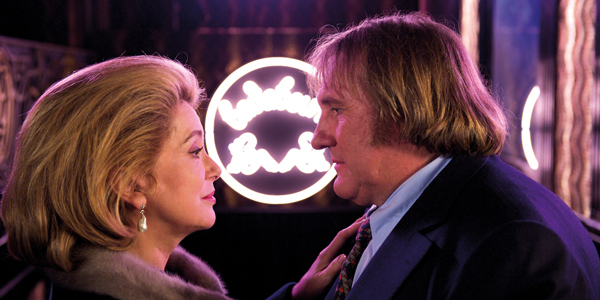
My trip to Edinburgh last week to assist my son and his fiancée with their move to a new flat was book ended by two visits to the RBC Film Theatre, one excellent and one not quite as good.
 |
| Filippo Timi as Mussolini |
The story of Benito Mussolini’s first wife Ida Dalser makes for a very powerful movie. Dalser fell in love with ll Duce just before the outbreak of the First World War when he was still a militant socialist. To help the future leader create his socialist journal Avanti Ida sold all her belongings including her apartment and her shop. Although no documentation has ever been found an alleged marriage took place in 1914 followed by the birth of a son in 1915, also called Benito. Mussolini came back from the war in 1917 with changed political ideals: he abandoned socialism and founded fascism. In 1919 he went on to establish what would become the National Fascist Party. Three years latter Mussolini seized power and became the supreme leader of a totalitarian state. Once the dictator was in power Dalser and her son were put under surveillance and any paper evidence of their relationship was tracked down and destroyed by the ‘state’ in its attempt to erase all traces of her and her son but she continued her fight to gain recognition for them both. Eventually she was incarcerated in a ‘medical’ institution and no longer allowed to see her son. Eventually they both died in obscurity in separate mental institutions.
 |
| Giovanna Mezzogiorno as Ida Dalser |
Marco Bellocchio has always been a critic of both Italian politics and its religious hypocrisy and with this his latest film his beliefs are plainly on view. The veteran filmmaker directed and part wrote the screenplay for
Vincere (2009) with Daniela Ceselli. Although the film is a slow starter and some of the editing leave’s a little to be desired, the longer it went on the better it got with great use of archive footage and presenting some very strong images. Mention should be made of the impressive acting from the two leads, the proud stubborn Ida Dalser is beautifully played by Giovanna Mezzogiorno and Filippo Timi plays both Benito Mussolini before 1922 and as his adult son.
Director Andre Techine latest film offers us no easy answers. The French drama
The Girl on the Train (2009) was inspired by a true story that shocked France in July 2004. It involved a troubled young woman who inflicted knife wounds on herself, cut out pieces of her hair and inscribed swastikas on her stomach; she went onto claim that she was a victim of an attack by a gang of anti-Semitic hooligans on a busy suburban Paris train who mistook her for a Jew. Some of her attackers, she alleged, where black.
 |
| Emile Dequenne and Nicolas Duvauchelle |
The film is divided into two parts. The first entitled ‘Circumstances’ tells how Jeanne (Emile Dequenne) lives with her dotting mother Louise (the ever beautiful Catherine Deneuve). How she fails to get a job with the well respected Samuel Bleistein a Jewish lawyer and old flame of her mothers. How she falls in love with Franck (Nicolas Duvauchelle) an edgy young working class wrestler who finds them both work as caretakers of an electrical shop while the owner is away. We discover that this shop is a cover for drug dealing and when Franck has words with a dealer he is stabbed in an ensuing fight and arrested by the police. Following his near death incident he rejects Jeanne blaming her for his misfortune.
 |
| Emile Dequenne and Catherine Deneuve |
The second part is entitled ‘Consequences’ and recounts the aftermath resulting from the above including the RER suburban train attack and the national outrage that followed.
Great acting from a very good cast especially the scenes between Jeanne and Franck which leaves you sitting on the edge of your cinema seat waiting for something unpleasant to happen. An interesting, absorbing watch.

 Carol Ledoux (Catherine Deneuve), a young Belgian
manicurist, lives with her elder sister Helen (Yvonne Furneaux) in Kensington London.
When Helen goes to Italy for a few days with her married boyfriend Michael (Ian
Hendry), she leaves her younger sister alone in the large, gloomy flat, which
deepens this unstable young women’s paranoia. Two men are attracted to the beautiful Carol,
one of which is the well-intentioned Colin (John Fraser) the other is her
sisters slimy lecherous landlord (Patrick Wymark). Unable to except either in
her singularly private world she reaches the brink of her personal insanity.
Carol Ledoux (Catherine Deneuve), a young Belgian
manicurist, lives with her elder sister Helen (Yvonne Furneaux) in Kensington London.
When Helen goes to Italy for a few days with her married boyfriend Michael (Ian
Hendry), she leaves her younger sister alone in the large, gloomy flat, which
deepens this unstable young women’s paranoia. Two men are attracted to the beautiful Carol,
one of which is the well-intentioned Colin (John Fraser) the other is her
sisters slimy lecherous landlord (Patrick Wymark). Unable to except either in
her singularly private world she reaches the brink of her personal insanity.