Thursday, 30 April 2015

Still Alice.


My blog of the latest screening at the Film Club located at the Robert Burns Centre Film Theatre in Dumfries is based on the film Still Alice (2014), having never read Lisa Genova’s 2007 novel of the same name. It was Anne Barclay, our host for the evening, that informed us that the debut novel was originally self-published but when it started to receive a lot of attention it was acquired by Simon and Schuster who published it in 2009 and has since been translated into 31 languages. Originally adapted for the stage it run in Chicago between April 10th and May 19th 2013 before it was adapted for the big screen, directed by Richard Glatzer, who died of complications from amyotrophic lateral sclerosis in March 2015, and his partner Wash Westmoreland.
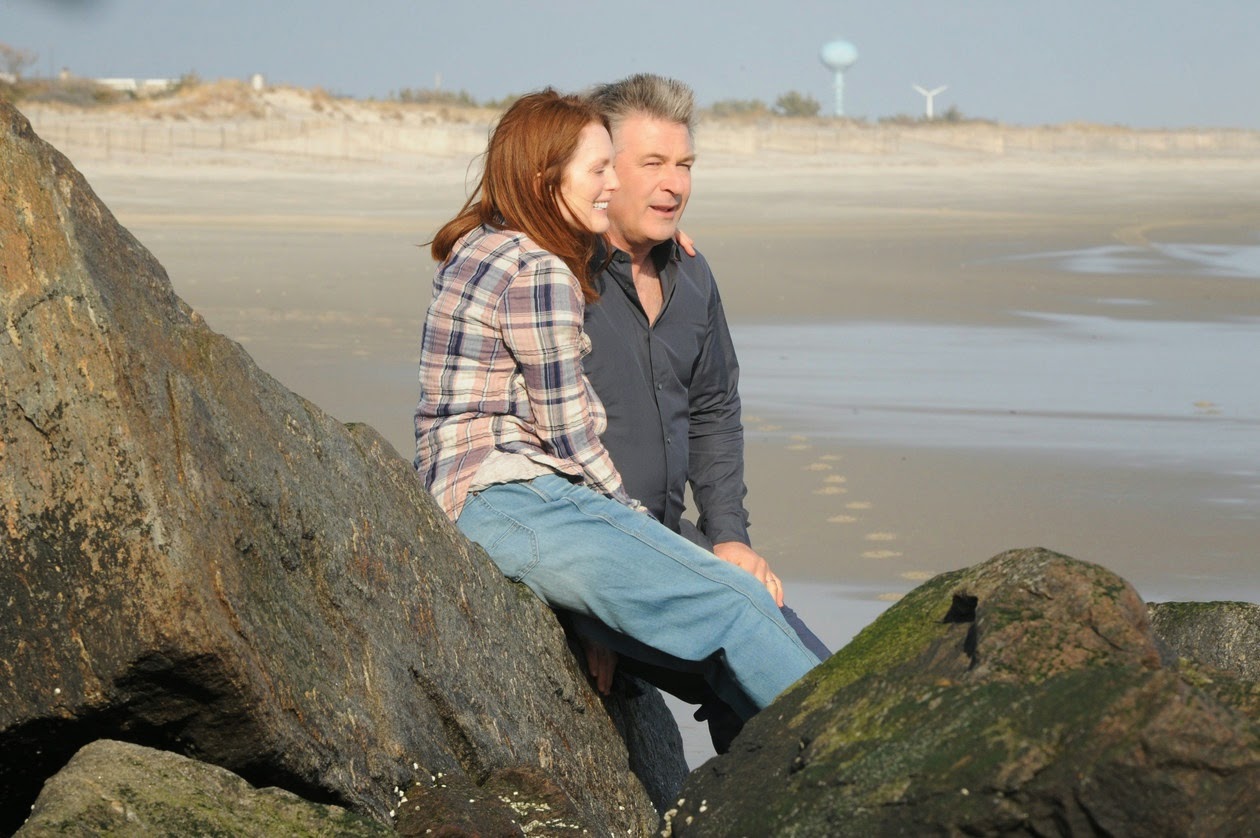
 
Sharing an intimate moment with her husband.
The film stars Julianne Moore who won an Oscar for her role as Doctor Alice Howland a linguistics professor at Columbia University who is diagnosed with early onset familial Alzheimer’s disease. This term is used to describe cases of Alzheimer’s disease diagnosed before the age of sixty-five of which a person’s child can generically inherit, but otherwise shares the same traits as the late onset form of Alzheimer’s. The story demonstrates how the disease gradually affected Alice Howland along with the effects on the other members of her family, including her husband John (Alec Baldwin), her eldest daughter Anna (Kate Bosworth), her son Tom (Hunter Parrish) a junior doctor and Alice’s youngest daughter Lydia (Kristen Stewart) an aspiring actor. The film picks up the story just as Alice is celebrating her fiftieth birthday and we witness her gradually loosing her word power while still carrying out lectures and how she forgets where she is during her daily jogging on the university campus. It’s after a visit to her doctor that the disease is diagnosed. This traumatic news resonates through her family, as her three children could also be carriers as well as the twins that Anna is carrying.
 
Alice's younger daughter played by Kristen Stewart.... 
....and her older daughter Anne (Kate Bosworth)

I can’t help but think how much better this film could be under the auspices of a British director, but don’t get me wrong Julianne Moore deserved her Oscar and the rest of the cast play their roles with conviction. My problem with the movie is that the gloss put on the film by the American directors hides to some extent the seriousness of its disturbing subject matter. A much more down to earth approach would have produced a far better film in my opinion. The subsidiary characters on display where not particular likable, in fact I would describe them as selfish minded - big teeth, big smiles in other words a typical middle class American family. The father refused to take time off work to be with his wife before the dementia finally took its toll, due, he claimed, to financial problems but he owned two houses!  Anna, who was due to give birth to twins, gave not a second thought to having the babies knowing that they could be also effected as she was. What I’m trying to say is that I could not empathies with any of these characters, other than possible Alice. A far better film that dealt with a similar subject was Away from Her made in 2006 by Canadian director Sarah Polly and starred Gordon Pinsent and Julie Christie as a couple whose marriage is put to the test when Christie’s character begins to suffer from Alzheimer’s. Another film I would highly recommend on the subject of early onset Alzheimer’s is the South Korean movie Poetry (2010) directed by Lee Chang-dong. Both these films treat their subject matter in a very much more down to earth fashion, as I’ve said, something Still Alice lacks.  
 

Wednesday, 29 April 2015

The Falling.


Seeing the statement 'a film by Carol Morley' is a recommendation in it self. Having previously seen two of her films, her first full-length feature film Edge (2010) which tells about a collection of random misfits who descend on the hotel on the Sussex coast of England in the middle of a snow-covered winter landscape, and her docudrama Dreams of Life (2012) a movie which attempted to reconstruct the life of a 36 years old young woman, Joyce Carol Vincent, who lay dead for 3 years in her London flat, I was looking forward to seeing her latest feature film outing as writer and director.
 
Carol Morley.
Set in an Oxfordshire all girls day school in 1969 The Falling (2014) is about sexual hormonal hysteria driven by sexual repression of a group of teenage girls and there female teachers. The two main characters are Lydia ‘Lamb’ Lamont (Game of Thrones Maisie Williams, who based on this role certainly has a future in the industry) whose father has run off leaving her agoraphobic mother Eileen Lamont (Morley regular Maxine Peake) to look after her and her brother Kenneth (Joe Cole). At school Lydia becomes infatuated with the sexual permissive Abigail Mortimer (Florence Pugh) and they form a very close loving friendship, not just exhibited by carving their initials in a tree but by some very intimate integration between the two friends. After a rather unexpected event, which places Lydia in the limelight, the school is involved in an epidemic of the hysteria manifested by fainting spells.
 
Best of friends Abigail and Lamb.

The agoraphobic Eileen Lamont.

This movie should put Carol Morley up there with other British female filmmakers of stature including Lynne Ramsay, Clio Barnard and Andrea Arnold. It’s a powerful fascinating film, poetic, with an autumnal dream like landscape helped by the cinematography of Claire Denis’s long time calibrator, the French born Cesar Award winning Agnes Godard and her 1960’s camera lenses. The original soundtrack is by Tracy Thorn who is best known as one half of Everything but the Girl. The viewer is forced to decide what is realism and what is alternative reality in a film that certainly crosses the boundary between the two with its deep-rooted sexual awakening of young womanhood.    


Friday, 24 April 2015

Dear Mr Prohack.


Dedicated respectfully to that great little huge body of men and women – The British Civil Service[1]

Dirk Bogarde was not very happy with his role in Dear Mr Prohack (1949) and to be honest his future acting ability had not quite come to the fore at this stage in his career. He plays Charles Prohack son of Cecil Parkers Arthur Prohack a high-ranking treasury official who unexpectedly comes into a quarter of a million pounds (it was quite suppressing what you could do with this amount of money 66 years ago!). This rather lightweight comedy rests somewhat on Prohack seniors public prudence and his private recklessness and as a satire on Civil Service red tape.
 
"He's been spending money Doctor"
This Wessex Film Production was made at Pinewood with location shooting carried out in London, which in this film shows no sign that WW2 had only ended a few years before! Adapted and updated by Donald Bull and Ian Dalrymple to represent 1949 from Arnold Bennetts novel Mr Prohack and the play, which also starred Cecil Parker, by Bennett and Edward Knoblock. This was the last film directed by American Thornton Freeland whose career spanned some 26 British and American films between 1924 and 1949 including the Fred Astaire, Ginger Rogers’s movie Flying Down to Rio in 1933.
 
Bogarde has his head turned by Glynes Johns.
The best thing about this movie is its great cast. As well as Parker, who acting skills were summed up beautifully as “wobbling of jowl, fluting of voice, cluttering of harassed hand, a master of disconcerted flappability” by Robin Cross[2] and the early role for Dirk Bogarde, we had Hermione Baddeley (It Always Rains on Sunday 1947, Brighton Rock 1947) as Mrs Eve Prohack, Glynes Johns as Arthurs private assistant and his sons love interest. Other familiar faces in minor roles include Denholm Elliott in his first feature film, future director Bryan Forbes, Elwyn Brook-Jones, a very quick glimpse of Ian Carmichael as a hat salesman and even a future Doctor Who, Michel Pertwee. More of a farce than a comedy, which included a rather strange dream sequence involving Cecil Parker! Strictly for fans of antediluvian British movies.     

Punch Cartoon.


[1] Opening credits.
[2] Robin Cross - Book of British Film.

Wednesday, 22 April 2015

Easy Money 2: Hard to Kill.

This second film in Swedish franchise based on Jens Lapidus’s novels Snabba cash has a very penultimate feel, seemingly dedicating itself to setting up the third film in the series. Easy Money 2: Hard to Kill (2012) is a follow up to Easy Money released in 2010. This time we have Babak Najafi at the helm instead of Daniel Espinosa but the story continues basically from where the previous movie finished. We now find Johan ‘JW’ Westland sharing a cell in the State Prison with Mrado Slovovic. Mrado, following the shooting at the end of the previous film, is now confined to a wheel chair but surprisingly both men are getting on really well! When JW is on release from prison to help him adapt ready for his permanent release he decides not to go back and instead arranges an escape plan for his crippled cellmate. Meanwhile the man with nine lives Jorge Salinas Barrio, who is also on the run from prison, sets up a drug deal to end all drug deals and Mahmud owes a large sum of money to the Serbian Mafia and must pay it back on the threat of his life.


Another cracking yarn where we again observe Stockholm’s sinister underworld and its racial tensions. The cast has not changed with Joel Kinnaman as JW, Matias Varela as Jorge, Dragomir Mrsic as Mrado and the Lebanese born actor Fares Fares as Mahmud.  Maybe not quite as exciting as the previous outing but certainly gives you an appetite for Easy Money 3: Life Deluxe.