Showing posts with label Steve McQueen. Show all posts

Wednesday, 26 November 2014

The Magnificent Seven.


People often asked what are my favourite movies and my normal answer is that I watch so many that I could not really say. But I going to let you into a secret, I do have three films that I saw at the cinema on their initial release and since have seen them many more times than I care to remember!
 
Chris Adams
I knew when I came out of the film theatre in Enfield some thirty-five years ago that I had just witnessed something really special. Since then I have watched the 1979 original and the 2000 Redux many times at home. In 2011 I had the privilege to watch Francis Ford Coppola’s restored and remastered Apocalypse Now (1979) on the big screen again at the Robert Burns Centre Film Theatre and after all these years it had finally been confirmed: this is my all time favourite movie the one I hate to love! It’s an American epic war film set during the Vietnam conflict, directed and produced by Francis Ford Coppola and starring Marlon Brando, Martin Sheen, and Robert Duvall. It deals with the psychology of war and follows a special operations officer sent to kill a U.S. Army Colonel who had gone ‘native’.
 
Vin Tanner.
Then of course there's Quentin Tarantino's  ‘cool universe’, a place that is hard and fast, funny, stylish and filled deliberately with some clever references to other cinematic works. Pulp Fiction (1994) is a film that defined American cinema in the 90’s. A piece of cinematic work that is central to its age, influencing many films that followed. A film that veers back and forth between humour and violence, a film where your never sure if you should be laughing or cringing.
 
Britt
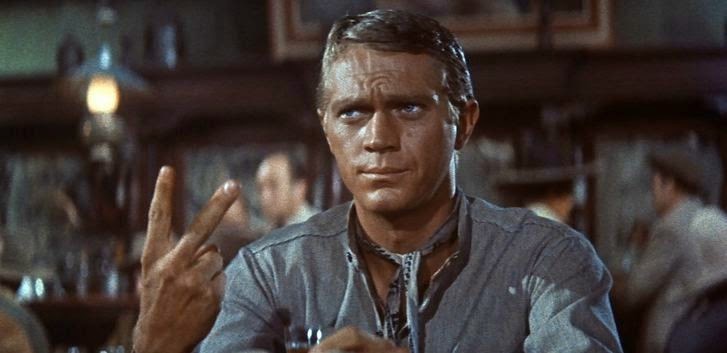
But the film I’ve seen the most over the years is a western, which as a wee boy was my favourite genre. I first saw The Magnificent Seven in 1960 when it was released and have lost track of how many times I've seen it since. Revisiting  A Fistful of Dollars (1964) recently gave me an inclination to see the John Sturges movie one more time. For some strange reason it has never lost its appeal from seeing it at the Angel Islington cinema as a schoolboy some 54 years ago. For me it has a familiar, comfortable feel but is still totally engaging and manages to bring an emotional lump to my throat from the first time we meet Chris Adams (Yul Brynner) and Vin Tanner (Steve McQueen) taking a dead Indian in the hearse up to the towns Boot Hill to be laid to rest. There they meet armed opposition which is quickly dispensed with by these two gun fighters, then up comes the now familiar Elmer Bernstein score, the hearse is driven at speed back to the undertakers office much to the enthusiasm of the towns inhabitants and passing travellers. This brilliant scene sets the tone for the rest of the film.

Harry Luck.

I'm sure your familiar with the story that was specifically adapted from Akira Kurosawa’s 1954 masterpiece (and I don’t use that term lightly) Seven Samurai with Sturges adapting it to fit into the western genre with the Ronin, master less Samurai, replaced with gunfighters.
We are south of the border in Mexico, in a small village where its farmers are being harassed by the bandit Calvera (Eli Wallace) and his men who invade the village and steal some of the crops that’s have been stored following their harvest, threatening to return and take the rest. Some of the more adventurous villagers want to buy some guns and fight the bandits next time they pay them a visit. To this purpose they travel across the border into America and set about buying the weaponry they require. Witnessing the successful conclusion to the burial of the Indian they approach Chris and ask him to buy the guns for them. Although dressed in black and an obvious gun fighter he seems an honest man and when he offers them the advice that it would be cheaper to buy men with guns, rather than just guns they readily except his help in hiring the gun fighters they require to carry out the task that the farmers are not really competent to carry out themselves. Thus begins the recruitment of men to join Chris in this crusade back across the Mexican border.

Bernardo O'Reilly.

Obviously the handsome drifter Vin, who has since riding shotgun on the hearse lost what money he had on the gaming table in a Saloon Bar, joins Chris in his recruitment drive. The next to join is Britt (James Coburn) a man with little to say who is as good with a knife as he is with a gun, a man whose not interested in money (the farmers are only offering $20 for a six week contract!) only the challenge. Next up is Harry Luck (Brad Dexter) a very old friend of Chris who believes there’s more to it than it than just $20!  Next they find Bernardo O’Reilly (Charles Bronson) chopping wood for food, he is a veteran gunfighter who has taken part in the range wars for money but has fallen on hard times.  After killing the Johnson Brothers in a gunfight the smartly dressed Lee (Robert Vaughn) is on the run and looking for somewhere to hide, what would be better than to hide out in the middle of a small war? What Chris doesn’t know is that this slick combatant is having a crisis of confidence!  The final and seventh member of the group is the young, good looking, ex dirt farmer Chico (German actor Horst Buchholz) who is trying desperately to prove himself.  This miscellaneous collection of human kind then set out across the border to our small village in Mexico scare away the Bandidos and the fun really starts.

Lee.

Filmed in Cuernavaca and EStudios Churbuso Mexico this was alleged to be the last great western before Leone reinvented the genre (see A Fistful of Dollars and the Spaghetti Western). John Sturges had directed westerns prior to this film including Gunfight at the OK Corral in 1957 where Burt Lancaster teams up with Kirk Douglas to gun down some bad men. Although nearly all the main cast in The Magnificent Seven are now household names, at the time only Brynner was well known having recently won an Academy Award for The King and I (1956) and was also starring opposite Charlton Heston in the biblical epic The Ten Commandments the same year. But other than perhaps Brad Dexter all the rest went on to enjoy very successful careers in the movie industry. McQueen, Coburn and Bronson would team up with the director again in 1963’s The Great Escape, which made Steve McQueen a superstar.  With the death of Eli Wallach in 2014, Robert Vaughn is the last living main cast member.

Chico.

Other than to say that this magnificent western is the one to pass down to your children, as I did with my son, I will end by paraphrasing the film notes that are included with the “ultimate DVD edition”. It explains that what sets The Magnificent Seven apart from the westerns that preceded it is the fallibility and fatality of the characters.  It’s the end of an era, and they are painfully aware that there breed is become obsolete. They also recognise too late what they have missed out on along the way, a permanent home, someone to settle down with, and even perhaps children. Quite simple, they have no place in a world that is rejecting their kind. They take the job of defending the village not merely because they are broke, but because this is there life, their very identity. And they will sacrifice themselves rather than be any less than they have always been - what noble thoughts are these; certainly they would not be found in the spaghetti westerns that followed the making of this memorable movie.  For western fans of all ages, this is the film to watch as a prime example of what was sometimes a great tradition: the American Western movie, never has it been done better.


Calvera.

Monday, 24 February 2014

12 Years a Slave.


There is no sin: I can do what I like with my property” says cotton plantation owner Edwin Epps when whipping a female slave, the same slave he rapes on a regular basis. This one episode really sums up the mentality between people who are financial capable of ruling other’s of a lesser social standing.  London born Steve McQueen’s third film, after his debut Hunger (2008) that dramatizes the events in the Maze, 6 weeks prior to Bobby Sands death on the 5th May 1981 and Shame (2011) a film that involved sex addiction, is based on a 1853 memoir written by Solomon Northup a free African American[1], married with two children living in Saratoga Springs, New York who earned his living as a skilled carpenter and fiddle player who is duped, kidnapped and ends up as a slave to William Ford in the Southern States of America. 12 Years a Slave (2013) is the story of Northrup’s experiences working and living as a slave for twelve years of his life unable to admit to his masters who he really is and having to deny the skills he learnt as a free man, all in fear of a near death beating, and going as far has having to except a different name ‘Platt’.
 
'You just don't have any say boy'
The superb screenplay is by John Ridley; the cinematography was the responsibility of Sean Bobbitt who had worked on The Place Beyond the Pines (2013) and the vampire movie Byzantium (2012) as well as McQueen’s previous two films. German born Hans Zimmer, who has been answerable for over 100 films, composed the soundtrack. The ensemble cast is notable for performances from Lupita Nyong’o as Patsey the young and beautiful slave girl that Epps has love hate relationship with, the vicious slave owner Edwin Epps is played by another McQueen regular Michael Fassbender, with William Ford a kinder, less aggressive plantation owner performed by Benedict Cumberbatch, Paul Dano, seen recently in Prisoners (2013) as Platt’s arch enemy John Tibeats and a small, but important role for Brad Pitt as Samuel Bass.
 
'A thin line between love and hate'
This is an exceptional film not just because it won a very deserving BAFTA for Best Actor for  Watching this historical drama exhausts you, drawing out every piece of emotion, a brutal, but moving film, that everyone should take time out to watch if for nothing more than to act as a lesson on how not to treat your fellow human beings. Bearing in mind that slavery can take many different forms, not always as psychically brutal as shown in the film but equally mentally demeaning.  Cinema to be appreciated rather than to be enjoyed. Chiwetel Ejiofor as Northrup and a BAFTA for Best Film, but also because it tackles a subject that is not normally told in such an honest and forthright manner.

'Southern trees bear a strange fruit'


[1] In United States history, a free Negro or free black was the legal status in the territory of the United States of an African American person who was not a slave. The term was in use before the independence of the Thirteen Colonies until the abolition of slavery in the United States in 1865 after the American Civil War, when the status ceased to have any relevance


Thursday, 27 June 2013

Hunger.


Bobby Sands was only 27 years old when he died after 66 days on hunger strike in the Maze Prison where he was serving a sentence for possession of firearms. He was the leader of the 1981 hunger strike in which Irish Republican prisoners sought to gain special category status. Sands was elected as a member of the British Parliament during his time in prison. His death resulted in an upsurge of support and interest in the Provisional Irish Republican Army.

Fassbinder as Bobby Sands.
 
Steve McQueen’s directorial debut film Hunger (2008) dramatises the events in the Maze 6 weeks prior to Sands death. Michael Fassbender gives a compelling performance in the lead role in what is a very gruelling and bleak movie. The film is notable for an unbroken seventeen minute scene where a priest, played by Liam Cunningham, tries to talk Sands out of his protest with the camera remaining in a static position for the duration of the scene. It is thought that this is one of the longest single scenes of its type in a mainstream film. Hunger was voted the best film of 2008 by the Sight and Sound Magazine.

Friday, 24 February 2012

Shame.


Portrait of a self loathing man.

On our RBC Film Club nights there’s always a lot of comment on what constitutes a good Monday night film. My own definition is that it must be a challenging watch and invoke a good follow on discussion (and preferable one that does not have a happy ending!)  This week’s film certainly fitted the bill. Shame (2011) described as a sex-addiction drama it was bravely introduced, at very short notice, by Rachel Findlay who started her verbal presentation by giving some background to tonight’s director. 

43 year old Steve McQueen was born in London and studied art and design at the Chelsea College of Art and Design moving on to study fine art at Goldsmiths College, it was here he first become interested in film and made his first short’s. After leaving Goldsmiths in 1993 he travelled to New York and studied briefly at the Tisch School of Arts but left because he deemed it not experimental enough. Citing his influences as the French New Wave and Andy Warhol his first major work was Bear (1993) although one of his best-known short films is Deadpan (1997) a restaging of the famous Buster Keaton movie where a house collapses around him leaving him unscathed, for which he won the Turner Prize in 1999. Both these films were in black and white and silent. He has also exhibited sculpture and photographs. In 2006 he went to Iraq as the official war artist. The following year he presented Queen and Country, a piece that commemorated the deaths of British soldiers who died in the Iraq War by presenting their portraits as a sheet of stamps.
Fassbender with Steve McQueen.
Rachel went on to tell us that McQueen’s first feature film was the award winning Hunger (2008) it starred Michael Fassbender who played Bobby Sands, a member of the Provisional Irish Republican Army who participated in a ‘no wash’ protest and led a hunger strike to apply pressure on the British government to grant the Maze prisoners political status. A story of a man that pay’s the ultimate price for his beliefs. 
Which brought us nicely to tonight’s film which like Hunger stars Michael Fassbender, whose debut was the award winning TV mini series Band of Brothers (2001) and has appeared in many feature films including 300 (2007) Angel (2007) Eden Lake (2008) Inglourious Basterds (2009) and Andrea Arnolds Fish Tank in 2009. His co-star is Carey Mulligan whose feature film debut was only 7 years ago as Kitty Bennet in Pride and Prejudice. Her best-known film to date is An Education (2009) for which she won various Best Actress Awards you may also have seen her in And When Did You Last See Your Father (2007) Public Enemies (2009) Never Let Go (2010) and the brilliant Drive (2011) with Ryan Gosling.
Carey Mulligan comes of age.
McQueen’s second feature film Shame co-written by Abi Morgan (Sex Traffic 2004, Brick Lane 2007) is set in New York City and relates the tale of alienated loner Brandon (Fassbender) whose life revolves around sex without commitment, he’s a man that cannot form relationships feeding his fetish with prostitutes and porno from his laptop. He lives in a minimalist impersonal apartment in Manhattan. But his mundane existence is jarred by the arrival of his uninvited fragile sister who has nowhere else to stay at present. A larger than life character, Sissy (Mulligan) unwittingly changes Brandon’s masturbatory habits throwing his very existence into turmoil.
"New York, New York"
Following our normal break for refreshment a larger than normal group of audience members returned to the auditorium to participate in the discussion. It was generally agreed that McQueen’s film was about addiction and not about sex and was a particularly challenging watch, being both disturbing and graphically realistic. I was impressed with the acting from both our leads particularly Carey Mulligan who really came of age in this movie with Fassbender giving a great portrait of a self loathing man that was trapped inside himself. The cinematography by Sean Bobbitt (Hunger) was brilliantly executed with some exceptional long shots including Brandon’s midnight run across Manhattan from the East River along 28th Street in a single shot of extraordinary beauty. McQueen is a very clever director that encourages us to connect with the characters by drawing inferences from the clues he assembles, acknowledging the intelligence of the audience unlike many films. Coming away from the theatre I was unsure about this film with it’s depiction of joyless sex and its lack of humour, but on reflection I believe this to be a benchmark in British film making and can’t understand why it has not been nominated in this years Academy Awards?