Showing posts with label Rachel Weisz. Show all posts

Thursday, 26 May 2016

The Lobster.


I agree with Peter Bradshaw when he writes that The Lobster (2015) “appears to run out of idea’s at its mid point”[1] It’s a film of two halves the first holds your attention but the second half can not be accused of the same.  The films turning point comes when the main character escapes the confines of the hotel and joins the loners in the woods. This dark dystopian satire is the work of Greek born Yorgos Lanthimos who has directed and produced some of the most atypical but enjoyable movies of the last few years including the chilling fairy tale Dogtooth in 2009 which deservedly won the Prix Un Certain Regard at 2009’s Cannes Film Festival, the strangely watchable Alps in 2011 and also worked as co producer on the appealing Attenberg (2010) one of Movie Rambles most blogged movies. As is quite normal with films that involve Lanthimos the synopsis makes strange reading….
 
David with the Lisping Man and the Limping Man.

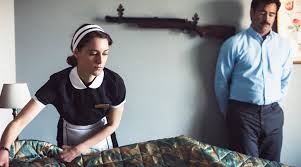
Sexual relief can only be administered by the Maid.

It’s the present, we are somewhere in a mysterious Europe country. David’s (Colin Farrell) wife has left him and we find him in a hotel where the rules state that if you don’t find a compatible ‘mate’ within 45 days you will be turned into an animal of your choice, in David’s case a lobster. David is there with his brother who has previously been turned into a dog. The Hotel Manager (Olivia Colman) sets the rules and they must be obeyed. Sexual relief by masturbation is not allowed but sexual stimulation by the hotel Maid (Ariane Labed) is. Dances are arranged so that partners can be viewed but to form a qualifying partnership with someone you must have something in common with each other. Everyone can extend their stay affording extra time to find a partner by hunting and tranquilizing escapees known as Loners who live in the nearby woods.  David decides to escape from the hotel and join the band of Loners lead by Loner Leader (Lea Seydoux). Here in the woods the rules are different. Above all they must remain single, romance and sex in any form is not allowed. Deviation from the rules is punishable by violence. 
 
Davids getting to know the Nosebleed Women....

....before joining the Loners and disobeying their rules.

You would certainly have to see the film to understand Lanthimos’s script and even then the movie probable requires more than a single viewing to fully understand the intricacies of this strangely hypnotic story.  The film has a great cast list, as well as these already mentioned it includes Rachel Weisz as the Short Sighted Woman, the lovely Jessica Barden as the Nosebleed Woman, Ben Whishaw as the Limping Man and old friend of Movie Ramble Michael Smiley as Loner Swimmer. Of all the films involving Yorgos Lanthimos that I have seen this is not his best work, interesting but not quite up there with his previous movies. It’s a real shame that the second half of the film was not as good as the first or it could have been one of his best outings.


[1] The Guardian 18th May 2015.

Thursday, 25 October 2012

Bourne Legacy.


Tony Gilroy wrote the screenplays for the first three Bourne movies all based on Robert Ludlum's novels, and has now stepped up to direct, as well as write, the latest instalment The Bourne Legacy (2012). With the original actor leaving the series we have a different lead character, not Jason Bourne (Matt Damon) this time but Aaron Cross/Outcome 5. Replacing Damon with Jeremy Renner (Town 2010, The Hurt Locker 2008) has given a new lease of life to the franchise after the rather disappointing third film The Bourne Ultimatum (2007), whose plot line incidentally overlaps this new film.


Cross and the Doctor attempt to make their escape.
Following public exposure by a Guardian journalist of the Blackbriar and Treadstone programmes and the on going investigation involving CIA Deputy Director Pamela Landy (Joan Allen) and former director of Operation Blackbriar, Noah Vosen (David Strathairn) it's decided to close down the complete Treadstone programme. This programme involved setting up a trained genetically modified kill squad involving Outcome agents. Intelligence chief Eric Byer (Edward Norton) takes the decision to not only eliminate all its field operatives, which obviously involves Outcome 5, but also their scientific backup team which includes Dr Marta Shearing (Rachel Weiss).

A good all round action drama, which included a very exciting and well-staged James Bond style ‘chase’ through the crowded streets of Manila. Ideal for passing a couple of hours on a Friday evening, and dare I say that I found Renner’s portrayal of a Bourne agent much more convincing than the previous incumbent?

Thursday, 24 May 2012

The Whistleblower.


Girls working the Streets of Bosnia. 

You can never do enough to raise peoples awareness of the despicable traffic in women and girls when they are transported from one place to another for the sole purpose of sex and making money for ‘pimps’ and ‘gangsters’ on the back of the misery generated by this evil trade.

Larysa Kondracki is a Canadian film director and screenwriter her debut feature film tackles this subject once again. Canada/German coproduction The Whistleblower (2010), similar to Sex Traffic (2004), bases its narrative on a true story. An American police officer Kathryn Bolkovac (Rachel Weisz) takes a job working as a peacemaker in post-war Bosnia. Although she expects to be involved in the rebuilding of this war torn country her good intentions are dashed when she uncovers ‘a dangerous reality of corruption, cover-up and intrigue amid a world of private contractors and multinational diplomatic doubletalk’[1]

Rachel Weisz with Kathryn Bolkovac.

It was this realization and her need to confront the truth that put Bolkovac in a precarious position. “For me it was really shocking,” Bolkovac, explains, “because I felt that my motives were genuine and I was here to help. I wasn’t here to hunt down police bad guys…when I began investigating the internal corruption involvement of our own police forces and our own internationals in the sick world of trafficking, I didn’t expect the backlash that I got.” As she dug deeper and deeper, the situation became untenable and because she was a threat to the face of the rebuilding project in Bosnia, the powers that be found an excuse to fire her. Bolkovac, being the person she is, filed a wrongful dismissal case against her employers and finally cleared her name in 2001.[2]

Rachel Weisz as Bolkovac.

Tagged as the movie the United Nations would prefer you didn’t see because of accusations that the U.N. top brass, the US State Department and again similar to Sex Traffic, a corrupt major US contractor who is contracted to supply American police for U.N. missions are all heavily implicated. Indecently the same company is still raking in US dollars in Iraq and Afghanistan under contract to the State Department. (Nothing ever changes)


As well as Weisz the film stars Vanessa Redgrave, Monica Bellucci and David Strathairn. It was filmed mainly on location in Romania and my only gripe with the movie itself is that some of the dialog was pretty difficult to understand which always tends to impair your enjoyment of what is potentially a worthwhile film.


[1] Synopsis
[2] Production notes

Monday, 9 April 2012

The Deep Blue Sea


Hester reflects.

Terence Davies latest film returns to the period of two of his two best-known movies. The first of which was his debut feature film Distant Voices, Still Lives (1988) This film focused on the real life experiences of Davies mother, sisters and brother whose lives were blighted by their brutal sadistic father. It’s a portrait of working class life in the 1940’s and 50’s Liverpool. Davies followed this up with The Long Day Closes (1992) another film that evokes the 1950’s, set in the Liverpool of his childhood. This autobiographical story display’s a montage of memories of the eleven-year-old boy. His latest film moves the location to North London but maintains the same post war timeframe. Davies was approached on behalf of the Sir Terence Rattigan Charitable Trust by producer Sean O’Connor to make The Deep Blue Sea (2011) as part of the writer’s centenary celebrations.

Hester loves Freddie but does Freddie really love Hester?

Davies free adaptation of Terence Rattigan’s 1952 stage play imparts the story of a 40ish married woman who leaves a 50ish loving husband and a comfortable life style for passion and sexual love an unusual thing for a women at that time. The film opens with an attempted suicide in front of an unlit gas fire that’s thwarted by the landlady and other tenants of the shabby boarding house in North London where Hester Collyer now lives with her lover the hard drinking Freddie Page a former RAF pilot who’s never recovered from the heightened experience’s of the Battle of Britain. We discover through flashbacks that Hester had left her kind and adoring husband, the High Court Judge Sir William Collyer in an attempt to find a passionate love affair with the emotionally immature Freddie. The movie very quickly demonstrates that all has not succeeded quite as planned.

This emotional triangle features some beautifully controlled acting from all three main protagonists. Rachel Weisz exposes the barely repressed sexuality of Hester, with Tom Hiddleston as the alluring Freddie, while Simon Russell Beale does a wonderfully restrained portrayal of Sir William. The casting of all three is exquisite each one totally convincingly at depicting the pain and anguish involved in this three-way relationship.

The hurt is obvious in Sir Williams eyes!

Terence Davies is probably one of cinema’s most underrated filmmakers, something I’ve never been able to comprehend. All of his films are exquisitely composed pieces of work. His trademark use of colour and composition of the lighting coupled with softness of focus and fluency of its camera work, this time by German DP Florian Hoffmeister, coupled with innovative use of music that always forms part of the narrative including the requisite communal sing-alongs. Davies is a director that always original and leaves a lasting impression on all connoisseurs of good film.

Coincidently part of the film was shot in Granville Square London WC1 just around the corner from where I first went to school, I had school friends living in the Square at the same time as this wonderfully composed drama was set!