One of the aims of the Robert Burns Centre Film Theatre Film
Club is to encourage you to see films that you would not normally buy a ticket
for. This weeks screening was one of those occasions, Norman McLaren Centenary Film
Tour (2014) is a film I would have not seen had it not been for the
Film Club. To start with I was not familiar with Norman McLaren’s work and the
description in our programme did not really draw me in – but how wrong could I
be? The programme of shorts, mostly made in Canada for their National Film
Board between 1938 and 1971, were in the main intriguing, inventive and
entertaining and the eight people that came to the screening were all of the
same mind.
Introducing this delightful series of short films was Film
Club regular Rachel Findlay who had already taken her two young boys to sample
the apparent pleasures of the McLaren
Animation Workshop also at the RBCFT where children and adults could not
only learn about the filmmaking techniques of this award winning animator but
could produce their own animated films using an app created by the NFB of
Canada. We were shown some of the work that her boys managed to master in 45
minutes on their iPad!
Rachel then gave us a short résumé of Norman McLaren’s life
and work, which I reproduce as follows:
 |
| Norman McLaren. |
Norman McLaren was born in
Stirling on April 11, 1914. As a high school student, he developed a particular
interest in painting. At the age of 18, he entered the Glasgow School of Art to
study interior design, but his enthusiasm for student filmmaking prevented him
from completing his assignments, and he never finished his diploma. His student
films were mainly live-action but at this time he also made three experimental
films including his first film where he painted directly on the surface of the
film stock. Most of these student films were entered in the annual Scottish
Amateur Film Festival, and as a result he was offered a job at the General Post
Office Film Unit in London. He was there for three years, where he made “nuts
and bolts” documentaries, thereby learning the craft of filmmaking.
In late 1939, he emigrated
to the USA. Whilst in London he had found quite accidentally that by making
marks with pen and ink on the soundtrack area of the film, he could make music,
and this is something he pursued further in New York, and indeed continued with
right up until the end of his career. In October of 1941, he emigrated to
Canada to work at their recently founded National Film Board. During the
remainder of the war, McLaren made five films directly related to the war
effort, and all but one were drawn directly onto the film frame-by frame. Once
the war was behind him, McLaren flung himself back into his personal
filmmaking. He returned to his experiments begun at art school where he used
the clear film stock as a canvas to paint on, now ignoring the frame lines
altogether. In 1949, McLaren went to China for UNESCO to teach audio-visual
methods to Chinese artists.
Throughout the rest of his
career McLaren worked using various techniques including paper cut-outs, live
action trick film, minimalist animation and further experimentation with
engraving directly onto the soundtrack area.
Between 1967, and his
retirement in 1983, McLaren made three films involving ballet dancers one of
these, Pas de deux, is in tonight’s programme. Following his retirement from
the NFB in 1983, McLaren turned away from filmmaking. He did, however,
completely revise the technical notes for his films, and also appeared in a
lengthy documentary about his work and techniques. Aside from gardening,
swimming and reading, his main retirement activity was the rekindling of his
interest in painting and drawing. He made several experiments for large-scale
colour stereo works, primarily with cut-outs. Norman McLaren died on January
27, 1987 at the age of 72.
Following this introduction we were treated to 13 varied
short films, some of which were exceptional and others not quite as good but
all were imaginative and not to long. Probable the easiest way to describe each
one is to list them separately.
 |
| Opening Speech (1961) |
Opening Speech
(1961). Norman McLaren attempts a welcome speech at the Montreal Film
Festival where a microphone, which has a life of its own, frustrates his
efforts. This entertaining wee film raised quite a few laughs.
 |
| Blinkity Blink (1955) |
Blinkity Blink
(1955). Features quite obscure images engraved directly onto film scratching
the images with razor blades and needles on to black film and then
hand-coloured the resultant “etching” against a soundtrack combining improvisational
jazz from composer Maurice Blackburn alongside sounds created by McLaren
scratched on to the films optical soundtrack. The films background was blank.
 |
| Le Merle (1958) |
Le Merle (1958). To me this film could be the forerunner of
music video. The simple white cut outs, representing a bird, played out on a
pastel sky looking background against a old French-Canadian folksong ‘Mon
Merle’ sung in French by the Trio Lyrique of Montreal.
 |
| Pas De Deux (1968) |
Pas De Deux
(1968). We have a screen with no defined borders on which a ballerina (Margaret
Mercier) dances with the images of herself before being joined by a male dancer
(Vincent Warren) to perform the pas de deux. The dancers appear to form silhouettes
against the black background. All choreographed to music by the Romanian Folk Orchestra.
This short film received 17 awards including the 1969 BAFTA Award for the Best
Animated Film along with an Academy Award nomination.
 |
| Synchromy (1971) |
Synchromy
(1971).
Again images to music but this
time synchronised to piano rhythms, which was a
logical conclusion to all McLaren’s experiments in animated sound.
He photographed sound card patterns onto the soundtrack area; and the visuals
were the same patterns, multiplied and coloured. “
To make
this film, McLaren employed novel optical techniques to compose the piano
rhythms of the sound track, which he then moved, in multicolour, onto the
picture area of the screen so that, in effect, you see what you hear”.
Definitely a sixties look about this short.
 |
| Lines Horizontal (1962) |
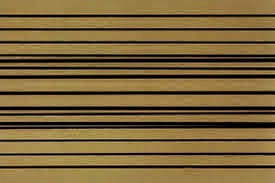
Lines Horizontal
(1962) is actually what you see for six minutes! Described as ‘an experiment in
pure design’ McLaren and Evelyn Lambert drew the lines directly on the film and
they go up and down to the especially composed music of folk musician Pete
Seeger. Reminds me of getting my eyes tested!
 |
| Neighbours (1952) |
Neighbours (1952).
This is McLaren’s best-known work and it won an Oscar in 1953 for Best
Documentary-Short Subject. This anti-war film was a direct consequence of McLaren's experiences in China and his
feelings about the Korean War. It uses a technique known as pixilation an animation technique using live actors as
stop-motion objects animated frame by frame like cartoon characters and
performing seemingly impossible feats. McLaren created the soundtrack by scratching the edge of
the film, creating various blobs, lines, and triangles that the projector read
as sound. The story involves a wee flower that grows between two houses. The
two pipe smoking men who live in the houses are happy at first to share the
single flower. But after a while they begin to argue over the plant and a white
picket fence goes up between the two houses. The men begin to physically fight
over who owns the yellow flower. We witness how man is turned into a ‘war like
savage’ with little regard to what started the fight in the first place! It gets
steadily worse with each man wrecking the others house and thereafter killing
each other’s wife and child. At the end we get left with two large graves and a
notice that reads ‘love your neighbour’
 |
| La Haut Sur Ces Montagnes (1945) |
La Haut Sur Ces Montagnes (1945) (The Top of these Mountains) Simply a
song sung over the images of changing mountain scenery that includes some
Christ like images. For the first time a chain-of-mixes (chiaroscuro) on a
pastel-drawn landscape. The idea for such a technique had been planted by
seeing Alexandre Alexeieff’s Night on
Bare Mountain in the late thirties.
 |
| V is for Victory |
V is for Victory or Buy my
Bonds (1941). The V for victory sign via a stick man is animated to music
by drawing directly onto 35mm film stock and synchronized to some stirring
military music by Sousa. Made for the war bond campaign.
Love on the Wing (1938). Said to be one of the weirdest
advertisements ever made for a public utility – Empire Air Mail. The
Postmaster-General thought it to be too erotic and too Freudian. The opening
credits say that it stars a Hero, a Heroine and a Villain and that the music
was by French composer Jacques Ibert. McLaren used a pen and black Indian ink
to draw the animation over a complex coloured background. (Click on link
to see it on You Tube).
 |
| Hen Hop (1942 |
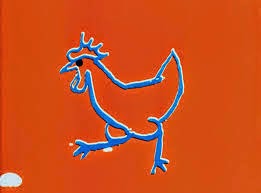
Hen Hop (1942). Experimental drawing on 35mm film stock with an
ordinary pen and ink. This ‘made without a camera’ short film features a jolly
dancing hen that became a McLaren trademark, to what sounds like Cajun music.
 |
| Begone Dull Care (1949) |
Begone Dull Care (1949). This cleverly crafted animation works
really well with the jazz music played the Oscar Peterson Trio. In partnership
with Evelyn Lambert, McLaren painted colours and shapes directly onto filmstrip
and the following comment by Donald Williams sums up this extraordinary psychedelic
experience. ‘For me, it is hard to
imagine a more satisfying jazz film - in this case, a marriage of hand painted
improvisations to the piano improvisations of a young Oscar Peterson’
 |
| A Chairy Tale (1957) |
A Chairy Tale
(1957). Back to the human form and similar to Opening Speech but involves a man, co-director Claude Jutra, trying
to sit on a chair which seems to be totally against the idea. It’s all played
out to the music of Ravi Shanker and Chatur Lal and works extremely well with a
‘sat happily ever after’ ending.
As I said at the start of this ramble Norman McLaren’s body
of work was a very pleasant surprise and the discussion following the screening
underlined this fact. I would expect that each of us who saw these short films
would have there own personnel favourites. Mine in no particular order are
Began
Dull Care,
Hen Hop,
Pas de deux and the anti
war film
Neighbours.
Click on the link to see each one on You Tube
and I am sure that you to will be pleasantly surprised.


