Showing posts with label Naomi Watts. Show all posts

Tuesday, 17 February 2015

Birdman (The Unexpected Virtue of Ignorance) .


It may be stagey and wordy but don’t let that deter you from seeing this outstanding American satirical black comedy. Alejandro González Iñárritu is a Mexican director that was responsible for helming some of the best films I have seen in the last 15 years, Amores perros (2000), 21 Grams (2003) Babel (2006) and Biutiful (2010) and he has now co-written, produced, and directed one of the most intriguing films I have seen in 2015. Birdman (2014) is the story of Riggan Thomson (Michael Keaton) who is trying to revive his career by writing, directing and starring in a Broadway adaptation of a story by the American short story writer Raymond Carver What We Talk About When We Talk About Love. Thomson had originally been a famous Hollywood star playing a superhero known as Birdman but is know virtually forgotten by most people other than his most devoted fans. Also involved in this make or break production are the producer Jake (Zach Galifianakis) Riggan’s best friend and lawyer, Riggans Girlfriend Laura (British actress Andrea Riseborough) his daughter and assistant Sam (Emma Stone) who is a recovering drug addict and first time Broadway hopeful Lesley (Naomi Watts).
 
Riggan and his alto ego.

McDonalds turn up everywhere. 

The rehearsals are not going well and one of the other actors doesn’t seem to be able to hack it. Fortunately for Riggan, but unfortunately for the actor, a rather large light fitting falls on his head therefore bringing any further involvement in the play to an abrupt end. A replacement is required post-haste and thanks to Lesley the replacement turns out to be none other than the brilliant but at times volatile, actor Mike Shiner (Edward Norton). By the way I have neglected to tell you that Riggan Thomson is tormented by strange occurrences where his alto ego Birdman speaks to him encouraging him to re-engage with his previous character which involves flying and making things levitate around his changing room! The involvement of Shiner in the production does nothing for Riggans metal state and as opening night approaches things are not looking good. 
 
Daughter Sam....

....girlfriend Laura....

....and hopeful actress Lesley.

This is a somewhat different movie from your standard cinematic release. The cinematographer Emmanual Lubezki, who has worked with Terrence Malick, The Coen Brothers and Alfonso Cuaron amongst many others, was tasked with making the movie seem like one long shot and his use of the camera is exceptional.  Antonio Sanchez composed the majority of soundtrack. The reason for using a Mexican Jazz drummer was explained by Iñárritu as enabling him to ‘structure scenes’ he went on to say in an interview “The drums, for me, was a great way to find the rhythm of the film... In comedy, rhythm is king, and not having the tools of editing to determine time and space, I knew I needed something to help me find the internal rhythm of the film." We get to see the drumming in various scenes sometimes in the corridor of the theatre and sometimes in the street; the great thing is that they are not part of the narrative! The score earned a nomination at both the Golden Globes and the BAFTA’s.
 
Discussions with Shiner are not going well....

....and the producer looks worried!

The best thing about this movie, other than its wonderful screenplay, is the acting, with Michael Keaton the stand out turn, but in reality all the other members of the cast are not to far behind Keaton’s high standards: this is supported by the fact that it has been nominated for nine Academy Awards including Best Actor for Keaton, Best Supporting Actor for both Emma Stone and Edward Norton and Best Director for Iñárritu.  It’s a film I would certainly recommend you go to see, and as I have said about this director’s previous work all his films are on a different level from your normal boring mainstream multiplex offerings and Birdman is no different.


Wednesday, 30 October 2013

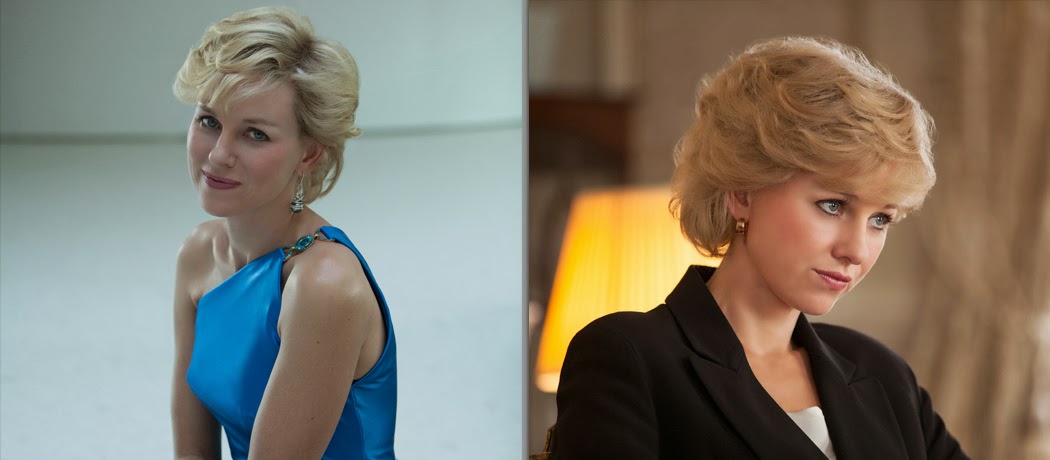
Diana.


It must be really tricky having the Queen of England as your mother in law especially if you have married her eldest son and even more so if you’re a free spirit? The adoration of the peoples Princess went deep into the British psyche and this shy looking young woman, who was supposed to be Queen herself one day, even wooed some die-hard republicans.  Lady Diana Spencer married the Prince of Wales on the 29 July 1981 becoming the Princess of Wales. The marriage produced two sons William and Harry who were respectively second and third to the British throne. The marriage ended some 15 years later with a divorce. One year later on the 31st August 1997 the fairy tale Princess was fatally injured in a car crash in the Pont de I‘Alma road tunnel in Paris along with her companion Dodi Fayed and the driver Henri Paul. The movie Diana (2013) endeavours to shed some light upon the last two years of her life.

Adapted for the big screen by British playwright Stephan Jeffreys[1] from a novel by author and filmmaker Kate Snell entitled Diana: Her Last Love released in 2000. The film is really an attempt at telling a love story, one that would not be very interesting if it did not involve a real life controversial princess. It reveals Diana’s unexpected and empowering relationship with heart surgeon Dr Hasnat Khan the man, it is alleged, she was very much in love with and wanted to marry. But the problem was the media attention that she attracted everywhere she went, which for Khan presented a problem.
 
Naomi Watts and Naveen Andrews.

Dr Hasnet Khan and the Princess of Wales.

Directed by Oliver Hirschbiegel, who was responsible for the 2004 German film Downfall that depicted the final ten days of Adolf Hitler’s life in the Berlin bunker in1945, and starring British born Australian actress Naomi Watts as Diana with Naveen Andrews, probable best known for his role of Sayid Jarrah in the TV series Lost (2004 -10), as Hasnet Khan.

Originally I was not totally convinced by the story but since looking up some background on the love affair I found the basis of the story to be true although Khan has allegedly said that Kate Snell’s story is only based on speculation and gossip?  The only reason I went to see the movie was out of curiosity and I certainly did not expect to actually like it especially after all the negative publicly which I am convinced kept the public away from the screenings at my local cinema. I thought Naomi Watt’s performance actually captured the tragic and sad life of someone who seemed to have every material thing that money and fame can offer but she could not get what she really wanted most of all: love.


[1] Wrote the screenplay for The Libertine (2004), which starred Johnny Depp. 

Friday, 16 March 2012

J Edgar.


J Edgar Hoover.
This weeks Robert Burns Centre Film Theatre’s Film Club screening had all the right ingredients, a celebrated director, two of modern days best acting talents and the opportunity to tell a very interesting ‘true’ story. But before we had a chance to see if these ingredients worked themselves into a great movie Mrs Pat Pickering, who was our host for the evening, gave a very well researched and executed introduction.


Pat informed the large audience that the film we were about to see J Edgar (2011) was a American biographical drama, directed by Clint Eastwood, focusing on the long career of the director, of initially the Bureau of Investigation and then the Federal Bureau of Investigation up until his death in 1972 serving under a total of eight presidencies. The story started in 1919 with the Palmer Raids, they were attempts by the United States Department of Justice to arrest and deport, what they deemed, radical leftists and anarchists from the United States.

Helen Gandy Hoovers personal secretary.

While researching her introduction Pat realised how little she knew about Hoover, she understood that he was a strong personality, the head of the FBI and therefore an influential man in the politics of the USA. Most of her knowledge, like most other people in this country was gleamed from old films, like 1959’s The FBI Story showing the Bureau in a shining light and starring James Stewart, and The FBI TV programmes, the G-men who saved America from gangsters and terrorists. But the more she researched the more she recognized that there was a scary shadowy side to this man. These included privately kept files, investigations into people of a differing political persuasion to himself, communists, blacks and civil rights activists and strangely enough in Hoover’s case as it turns out, homosexuals. 

John Dillinger after he was shot dead by FBI Agent Melvin Purvis.

Hoover founded the FBI in 1935; Pat went on to tell us, and is credited with building the organisation into a large and efficient crime-fighting agency including the introduction of modern day police techniques including centralised finger printing and the use of forensic science in investigating crime. He was the power behind the capture, or as in the case of John Dillinger, the killing of dangerous criminals. These successes led to the broadening of the Bureau’s power. Prior to and during WW2 the FBI had primary responsibility for counter espionage and was credited with preventing German saboteurs and spies from gaining a foothold in the US. All this raised the profile of Hoover and he was seen as the protector of the ‘American way of life’.

Hoover with his close associate Clyde Tolson.

Continuing with this ever more interesting introduction Pat explained that later in life and certainly after his death Hoover became a controversial figure as evidence of his secretive actions became public. His critic’s, and there was many, accused him of exceeding his jurisdiction and using the FBI to harass politicians, amassing clandestine files by any means at his disposal including illegal methods.  Pat pointed out that since the days of Hoover, FBI Directors are now limited to one ten year term because of the power that Hoover had acquired over his long tenure.

Dorothy Lamour getting close with J Edgar.

The final part of the introduction touched of his private life as an alleged closet homosexual and cross dresser dedicated to, and dominated by, his mother (reminding this viewer, on seeing the film, of Hitchcock’s Psycho) and that Clyde Tolson, an Associate Director at the FBI may have been his lover. Suffice to say there has been a great deal of controversy about this side of John Edgar Hoover. All we know for sure is that that both men worked closely together and were also very close friends. When Hoover passed away Tolson inherited the Hoover estate and consequently moved into his home excepting the Stars and Stripes from the burial casket. Tolson is buried a few yards away from his close friend in the congressional cemetery.

Hoover ran a campaign to denigrate Martin Luther King.

It was obvious from Pat Pickering’s introduction that Hoover was a complex character that amassed considerable power during his lifetime and is still to this day an enigma. So, did the ingredients mentioned in my first paragraph succeed in making this movie an intriguing story about this rather enigmatic figure? I afraid in my humble opinion it turned out to be a missed opportunity. As Peter Bradshaw described it ‘a lot of pulled punches and fudged issues’ which I could not help agree with. Considering the films running time Clint Eastwood could have included some far more interesting peripheries like the killing of Dillinger, rather than just showing a death mask, his inability to investigate the Mafia and the campaign to denigrate Martin Luther King. The film, I felt, was preoccupied with looking at Hoover and not flushing out his fascinating story also skirting round the sexual ambiguities. Its told in drab rooms, under lit by Eastwood’s normal cameraman Tom Stern, the story mainly happens in flashbacks with Hoover seen dictating his life story to some young assistant, its these constant flashbacks that get annoying after a while, one minute with the young J Edgar and next with the much older man. Leonardo DiCaprio portrayed the young Hoover far more convincing than the older reincarnation. The part of Helen Gandy, Hoovers secretary for fifty four years, does not stretch a wonderful actress like Naomi Watts relegating the character to a bit part. Like a lot of modern movies of late its tedious, with no real emotion, tension or excitement, words not normally associated with a director of Mr Eastwoods class.


Thursday, 9 February 2012

Fair Game.


Joe Wilson and Valerie Plame.

Doug Liman’s (The Bourne Identity 2002) latest movie is a biographical thriller based on two memoirs, Fair Game: My Life as a Spy, My Betrayal by the White House written by Valerie Plame and the former United States diplomat Joseph C Wilson The Politics of Truth: Inside the Lies that Led to War and Betrayed My Wife CIA Identity: A Diplomat’s Memoir. Fair Game (2010) stars Naomi Watts as Plame and Sean Penn as her husband Joseph C Wilson. It’s retells the story of the outing of Plame, a former United States CIA Operations Officer, by the Washington Post after her husband questioned the White House’s use of evidence on the alleged existence of Weapons of Mass Destruction in Iraq. 

Naomi Watts as Plame.

In late 2001 Valerie Plame is appointed to manage the CIA’s Joint Task Force on Iraq, focusing on counter proliferation intelligence gathering. In late February 2002 Wilson travelled to Niger at the behest of the CIA to investigate their alleged sale of uranium to Iraq, although Wilson finds no evidence his report is used to confirm the British claim’s that the Iraqis are building nuclear weapons. Based on this British/American interpretation troops enter Iraq. Its when Wilson publishes his article in the New York Times exposing the distortion of his findings to serve the war mongers case that his wife is exposed publically as a CIA agent something even the couples closest friends were unaware of.

Sean Penn as Wilson.

This familiar fact-based drama has been converted into a taut, and for the most part interesting, political thriller with a great performance from Watts whose resemblance to the real Plame is uncanny. Sean Penn gives a great interpretation of a man of principal along with all the smouldering anger that’s involved. A very believable interpretation of these shadowy events. The film won the Freedom of Expression Award from the National Board of Review.