Tuesday, 16 May 2017

Whisky Galore! 1949


After a recent tour of the Outer Hebrides I thought that it was the right time to revisit, what is regarded as one of the best of the comedies to come from the Ealing Studios, Whisky Galore! It was released in 1949, which was a peak year for the studios with Passport to Pimlico and Kind Hearts and Coronets also released that year. 
 
SS Cabinet Minister runs aground.
Based on Compton Mackenzie’s 1947 novel of the same name, which it self was based on a real life incident that occurred in 1941 on the Hebridean island of Eriskay when the SS Politician ran aground with its cargo of malt whisky. The movie is set in 1943 and the Island of Todday is in disaster mode when it runs out of whisky, the staple tipple of the Outer Hebridean Island and because WW2 is still going full swing there is a problem replenishing the islands stock.  That is until a freighter on its way to America with 50000 cases of the uisge-beatha runs aground off the foggy coast. After the crew abandon the ship and before it sinks the locals organise to relieve the ship from its cargo. All seems fine until the Sassenach captain of the Home Guard calls in Customs and Excise officers to spoil the Islanders enjoyment of their ill-gotten gains.


Replenished stock. 

 Whisky Galore! was directed by American born Scottish director Alexander Mackendrick who also directed other classics including  The Man With The White Suit (1951), The Maggie (1954) and The Lady Killers (1955). The film stars Basil Radford as the formidable Captain Waggett, Wylie Watson as the wily storekeeper Joseph Macroon and the sultry Joan Greenwood as his daughter Peggy. Also involved in the shenanigans are James Robertson Justice, a very young Gordon Jackson, John Gregson and Finlay Currie whose voice can be heard narrating the movie. Also seen in a wee cameo role is the novels author as the SS Cabinet Ministers captain.
 
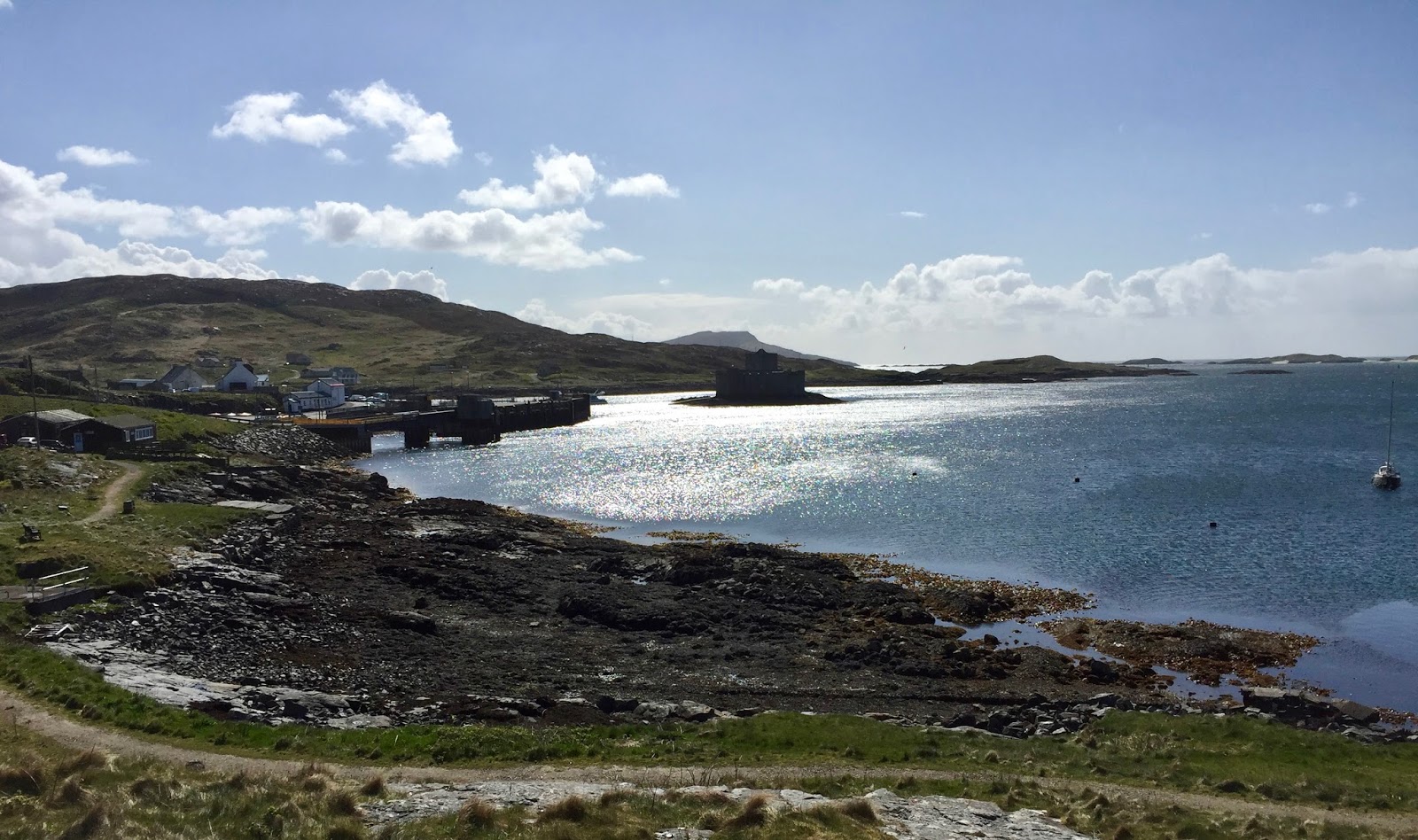
Castlebay Barra.

Kisimul  Castle.

The Church. 

Although the original incident took place on Eriskay the film was shot on location on the neighbouring island of Barra and main settlement of Castlebay can easily be recognised from the main street heading to the shore with Kisimul Castle in the background and the Catholic Church that overlooks the town centre. The movie brings out the closeness of the islands community and their way of life including the observance of the Sabbath which continues, for example on some parts of the Outer Hebrides where you can not purchase a Sunday paper until Monday. It’s also a grand example of how ordinary working folk can triumph over bureaucracy.  Not to be confused with any inferior remakes.

Eriskey Township. 

Eriskay Restaurant named after the original ship. 

-->

Thursday, 30 March 2017

Heavens Above.


Some critics believe that the last of the Boulting Brothers social satires Heavens Above (1963) deserves to be remembered because of Peter Sellers lead performance as the sincere Church of England clergyman who gets sent due to a clerical (no pun intended) error to the wrong parish and I would not disagree, but there is far more to the film than just Sellers award winning performance. It’s a clever and humorous satire on religion, the establishment and the working class and was called the Boulting Brothers most ‘human picture’ [1].
 
Sellers at his best.
The film is set in a small country town called Orbiston Parva that is over lorded by the Despard family, rich local landowners and proprietors of a factory that provides local employment. When we first meet the Rev. John Smallwood (Sellers) he is in a prison cell having been trussed up by a convict he has recommended to be made a trustee. The prison authorities are not unhappy to see their prison chaplain moved to another parish. But we soon discover that there are two John Smallwood’s and the wrong one gets sent to Orbiston Parva where chaos ensues.  Firstly he appoints a West Indian dustman as his churchwarden and then to make matters worse he moves the very large and unruly Smith family into the Manse.  Following these two actions things can only get worse and believe me they do.
 
Eric Skyes with a young future Small Faces star - Steve Marriott.
This British movie has an exceptional cast that’s far to long to list here but I would give special mention to Eric Skyes as head of the Smith family, Cecil Parker as the Archdeacon who recommends Smallwood for the Orbiston Parva parish and lives to regret it, Brock Peters as the churchwarden and Ian Carmichael in a guest appearance as the other Smallwood.  The films script was written by Frank Harvey, who was also responsible for writing the scripts for I’m All Right Jack (1959) and Privates Progress (1956), and based on an idea by Malcolm Muggeridge who also has a cameo role in the film.  

[1] Cecil Wilson Daily Mail 22 May 1963

Wednesday, 29 March 2017

The Great Wall.

Sometimes its best to ignore the critics and go with your gut feelings and The Great Wall (2017) is a fine example of this. After seeing the trailer for the film at our local cinema I thought it may be well worthwhile shelling out for two tickets to see the movie on the big screen, which in all honesty is the only place to see it to get the best out of the special effects, and I was not disappointed. This is an exceptionally enjoyable movie with action that never stops from start to finish. And believe me its great to have such worthy escapism at this time of political upheaval. 
 
William Garin.
This Chinese/USA co-production is a fantasy monster movie set in the Song Dynasty (AD 1010-63). The story involves a band of mixed race mercenaries who are hunting for the ‘black powder’ but are attacked by bandits who reduce their numbers down from twenty to five. Continuing on their journey they are attacked by an unknown creature who kills a further three men before it is killed by the head of the mercenaries William Garin (Matt Damon) who cuts off its arm, keeping as a trophy.  Along with his side kick Pero Tovar (Pedro Pascal) they continue their search. That is until they accidently stubble on the iconic Great Wall of China that is manned by The Nameless Order who are a special part of the Chinese Military and are all specialist in their own field of battle. Led by General Shao (Zhang Hanyu), Strategist Wang (Andy Lau) and Commander Lin Mae (the very attractive Jing Tian) of the Crane Troop who have the task of holding the wall against invaders. It’s not long before our two soldiers of fortune discover that the arm belongs to the invaders - the TaoTie are a massive horde of alien monsters who are now due to attack after a break of sixty years. 
 
Commander Lin Mae.

Strategist Wang

General Shao.


Directed by Zhang Yimou, best known for The Road Home (1999) and the action fantasies Hero (2002), House of the Flying Daggers (2004) and Curse of the Golden Flower (2006) with an imaginative screenplay co-written by director/producer/writer Tony Gilroy. The movie has a large Chinese cast and shooting took place in Qingdao in the Peoples Republic of China and incidentally this movie is the most expensive film ever shot in that country. 

Thursday, 23 March 2017

Brassed Off.


In 1984 Mineworkers in the Britain went on strike, not for more money or for better working conditions but to save their jobs, their way of life and their communities. The threat came from Margaret Thatcher and her Tory government. It was her aim to shut down the coal industry by closing pits, something that was denied at the time but has since been proved to be correct. Before the strike in 1983 there were 174 working pits, by 2009 there was only six and now there are no working pits in any part of Britain mostly due to one rather cruel and heartless woman.
 
A long lost breed of working men. 
Brassed Off (1996) was set during the pit closures the Tory Governments were determined to implement following the end of the miners strike in 1985. Its now 1992 and the miners of Grimley Colliery North Yorkshire are facing a very uncertain future when the closures threaten their small mining community. Because many of the mine workers believe that the redundancy offer will be excepted there is no point in keeping the local Colliery Band alive, but their passionate band leader Danny (Peter Postlewaite) is having nothing of the kind and wants to enter the band into the National Brass Band Championship to take place at the Albert Hall in London. Help to achieve this end comes from a surprising source. The beautiful and talented young granddaughter of a former bandleader returns to her hometown and is invited to join the band, raising the spirits of its members. Gloria (Tara Fitzgerald) also rekindles her relationship with Andy her childhood sweetheart. But when Andy (Ewan McGregor) and the other members discover that she works for the British Coal Board and is researching the pits viability to see if it makes financial sense to keep it open they ostracise her.

Danny leads the Colliery Band.

In hindsight we now know that that even if a coal mine was financially viable Thatcher’s masters wanted the pits closed. At its heart Mark Herman’s film, although there are some very humorous moments, has an underlying story about the hardships that were deliberately put upon the working men and women and their families along with the ruination of the industrial bedrock of the UK and the abolition of the organisations that represented the worker by an uncaring government and their wealthy cohorts only interested in the profit motive and power.


Still proud of their heritage (Durham 2016) 


-->
A very emotionally  poignant story whose cast is a credit to Herman’s script, acting out their roles with great feeling so much so that you can easily believe that they are committed to the underlying message that I believe the film sends out. If you have never seen this wonderful example of British filmmaking then I urge you to put that right immediately.  Either you have a heart of stone or think that the sun shined out of Thatcher’s backside not to empathise with what was happening. The workingmen and women of this country are still suffering with an extreme right wing government inflicting never ending austerity, zero hours contracts and a minimum wage that is so low it has to be topped up with in-work benefits. 

Monday, 6 March 2017

The Danish Girl.


Tom Hooper’s return to form after the dreadfully disappointing film version of Les Miserables (2012) is a fictionalised retelling of the story of a very brave and courageous human being. Based on David Ebershoff's novel of the same name, The Danish Girl (2015) is the story of Lille Elbe who was credited as one of the first identifiable recipients of sex reassignment surgery.


Lilli Elbe.

Born Einar Magnus Andreas Wagener in Venice, Denmark in 1882 as a male, met his future wife at the Royal Danish Academy of Fine Arts and married in 1904. Einar specialised in landscape painting while he wife Gerda illustrated books and fashion magazines. Einar love of dressing as a woman started when he was asked to wear stockings and heels so he could fill in for the ‘legs and feet’ of Gerda's absentee model Anna Larssen. Following this one simple incident he stared dressing, and in time identifying as a woman. He became the beautiful female model featured in his wife's best known paintings and accompanied her to many social functions in Paris where they moved in 1912. It was after this period in 1930 that this transgender pioneer Lilli Elbe went to Germany for what was at that time experimental sex reassignment surgery which would involve four operations over two years.
 
Gerda Wegener's portrait of her husband.
Gerda's self portrait.
The film stars Eddie Redmayne as Einar Wegerer/Lilli Elbe who was nominated for Best Actor in the 2016 Academy Awards and Swedish actress Alicia Vikander as Gerda Wegenar/Gottlieb for which she quite rightly won an Academy Award for Best Supporting Actress. Also included in the cast is Ben Whishaw as Claude Lejeune Lilli Elbe's lover, Sebastian Koch as Doctor Kurt Warnekros who performed the ground breaking surgery and Amber Heard as Anna Larssen Gerda's model and friend.
 
Alicia Vikander as Gerda Wegenar. 

There was some criticism for casting a cis actor in the main role but I believe Redmayne pulled it off but there certainly more to the story than was portrayed in Ebershoff’s book. Although it has been opined that Lucinda Coxen's screenplay allows a more truthful reflection of the story it still does not tell the whole story including the fact that Gerda Gottlieb had lesbian lovers leading to some critics accusing the film of being LGBT sanitised. A well-intentioned film that in my opinion does not go far enough.