Showing posts with label Isabelle Huppert. Show all posts

Tuesday, 3 June 2014

The Nun.


Directed and co-written by Guillaume Nicioux from the adaptation of an anti-clerical novel written by Denis Diderot which was intended as a practical joke ‘a compilation of letters he sent to a devout fiend in the guise of a desperate nun looking to leave the sisterhood[1].
 
Mother reveals her secret to her daughter. 
The story is set in 1760's France and reveals the dehumanising effect of cloistered life on a young girl. The young girl in question is the daughter of a once rich bourgeois family; her mother (German actress Martina Gedeck) admits that Suzanne is illegitimate. Because of the family's financial problems and her mother's deep feeling of guilt Suzanne Simonin (Pauline Etienne) is committed to a nunnery, very much against her will. When the kindly but manipulating Mother Superior Madame de Moni (Francoise Lebrun) dies the replacement turns out to be sadistic and cruel, compelling Suzanne to becomes ever more rebellious and strongly resisting the rules of the convent. Sister Christine (Louise Bourgoin) inflicts the worst forms of humiliation making her wear a hair shirt, administering beatings and depriving her of food and clothing. After complaining about her treatment Suzanne is transferred to another convent, where she discovers another kind of Mother Superior (the award winning Isabelle Huppert) one who tries to instigate an inappropriate affection towards her charge.
 
Although Suzanne has a devout faith she objects to being sent away. 
The Nun (2013) tells the story of a young woman trying to resist imposed religious values, revealing, as I have said, the dehumanising effect of a cloistered life. The highlight of this female led period drama is the scene steeling, over the top performance from Ms Huppert who demands more than faith from our pretty heroine? The film attempts to deal with not only the fanaticism and power of the Catholic Church but also the restricting class structures of 18 century France. It premiered in competition at the 63rd Berlin International Film Festival and won a Best Actress Award for Pauline Etienne.

Mother Superior forces her attentions!


[1] Henry Barnes.

Saturday, 27 April 2013

Home


French/Swiss director Ursula Meier debut feature film has been described as a road movie in reverse. Home (2008) involves a family of five, mum and dad played by Isabelle Huppert and Oliver Gourmet and their three children who for ten years have incorporated an abandoned motorway as part of their front garden. They use it for late night roller hockey, a paddling pool and an armchair straddle’s the lanes with the family satellite dish hooked up from the crash barrier in the centre reservation. Then suddenly the family’s private existence is shattered when the motorway is finally opened. Eldest daughter Julien (Adelaide Leroux) escapes while the remaining family members descend into the type of madness similar to that portrayed in Polanski’s Repulsion (1965). The movie is a metaphor for the horrors of the modern world and the sad decline of the family unit, displaying the way freedom can descend into a claustrophobic existence. Great acting from all involved in this original story with fantastic camerawork from famous French cinematographer Agnes Godard with her marvellous use of light and dark.  

Friday, 22 February 2013

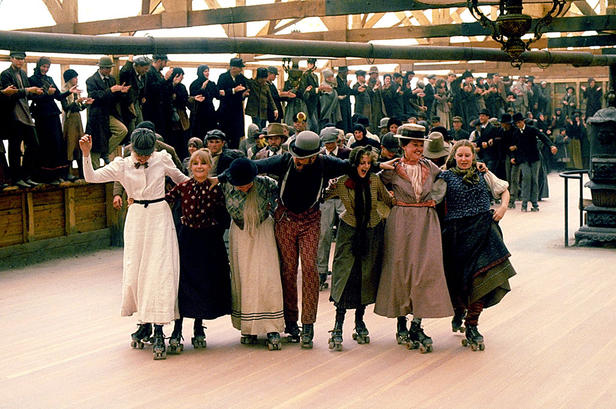
Heavens Gate.


Its not often that the sheer brilliance of a movie makes you want weep with joy, please don’t let anyone tell you that Michael Cimino’s Heavens Gate (1980) is not a masterpiece, because they would be lying! 

This giant of cinematic history was much maligned on its release. Originally it was considered to be one of the biggest box office flops of all time, costing in the region of $44 million and allegedly earning less than $3 million dollars in return. It brought its studio, United Artist, to near collapse and destroyed the career of an award-winning director. United Artist had given Cimino a free hand after the success of 1978’s The Deer Hunter but never again allowed a director driven film production! Problems with budgetary overspends, originally in the region of $11.4 million, time overruns, the planned release was for December 1979 but did not open until November the following year, and bad press added to its problems.

Written and directed by Michael Cimino its gripping narrative is really another demonstration of man’s inhumanity to his fellow man, a story about capitalism and greed and ethnic cleansing, showing the America system at its worse? The Wyoming Stock Growers association lead by Frank Canton is convinced the European immigrant settlers are looting their herds of cattle. Gaining the approval of the state, Canton and his fellow cattlemen draw up a death list with a 125 names of settlers from Johnston County who are accused of being thieves and anarchists.

The beautiful cinematography.........

The film boasts a well-known cast that includes Kris Kristofferson as Jim Averill an 1870 graduate of Harvard College who 20 years later finds himself the Marshall of Johnson County. A fair man who has no time for the cattleman’s association preferring the company of Ella Watson a Johnson County bordello madam who accepts cattle as payment for use of her prostitutes. Depicted, in her American feature film debut, by French superstar Isabelle Huppert. Watson also shares her affections with Nate Champion a friend of Averill and an enforcer for the stockmen who is portrayed in his normal laid back style by Christopher Walken. Also included in the cast are Jeff Bridges, Mickey Rourke, a very young looking John Hurt and Sam Waterston as the evil Frank Canton.


and the wonderful set pieces...........

The 2013 Glasgow Film Festival showed the restored version of the film, the 216-minute directors cut and not the massacred cut of 149 minutes. Released in 2012 and first shown at the 69th Venice Film Festival and subsequently at the New York Film Festival it now clearly demonstrates the stunning cinematography, the wonderfully choreographed set pieces and a sound that is incredible. The critics had finally woken up to the fact that it was “one of the few authentically innovative Hollywood films[1]” This “wounded monster” as David Thomson called it has found its rightful place up there among the great films of all time and finally been given the credit a film of this stature disserves.

make this one of the finest films your ever have the privilege of watching. 


[1] Robin Wood 1986.

Monday, 21 January 2013

Amour.


There is certainly no doubt in my mind that the German born director Michael Haneke is a master filmmaker. His name on the credits is reason enough to see a film and his latest movie Amour (2012) is a superb example of this mans sophisticated, challenging dramas. The cool precise direction manifests itself in the precise detail, the unhurried camera work that’s never afraid to linger and his use of long static takes to emphasize a point or an important moment. Using little or no incidental music his work always gives us an in depth study of human quality with all it’s weaknesses and strengths, in films like Funny Games (1997) where two young men enter uninvited the holiday home of a young family with the sole intent of murdering them, a film which skilfully evokes a very violent undertone without showing the act, The Piano Teacher (2001) about a female pianists masochistic obsession with her student, The Time of the Wolf (2003) a post-apocalyptic drama, in Cache (2005) we find a liberal intellectual haunted by fears of the exposure of a shameful childhood and The White Ribbon (2009) darkly depicts society and family in a German village just prior the second world war.


Jean-Louis Trintignant 

Amour is about compassion and the love between two people, not young love but a love that has grown from initial teenage lust through the birth of your children to a mutual loving respect in your later years. Our two leads, 82 years old Jean-Louis Trintignant and the beautiful 85-year-old Emmanuelle Riva, play George and Anne Laurent an elderly Parisian couple who live alone in a spacious flat in an upmarket apartment block. We first encounter the couple at a piano recital by one of Anne’s ex-students. Its obvious from the start that this couple are very much in love and don’t have a lot of time for other people even their grown up daughter Eve, played by Haneke regular Isabelle Huppert, appears an intruder in their lives. One morning Anne has a funny turn and on investigation it turns out to be a blocked carotid artery. The operation goes wrong and she is left partially paralysed making George promise never to allow her to go into hospital or residential care. Although not in particularly good health himself George is tasked with the care of his wife without normal palliative support. The film is based on an identical situation that happened to Haneke's 90-year-old Aunt and the issue that interested him the most was: "How to manage the suffering of someone you love?"


Emmanuelle Riva.

In this disturbing and moving depiction of Anne’s mental and physical deterioration Haneke never shy’s away from the living horrors of old age, immobility, dementia, and incontinence and done in his normal no nonsense manner with no recourse to sentimentality.  This writer and director has been quoted as saying that his films are easier to make than to watch which certainly is a truism, my wife, who accompanied me to the screening, had been at her mothers bedside when she passed away four days prior to seeing this movie, found it extremely difficult to stay the course. Will we all get to a stage in life were being capable of wiping your love ones arse rather than bringing them a bunch of flowers, proves more than love, more a life long devotion.

Haneke regular Isabelle Huppert.

My friend and film club colleague described the film as a harrowing watch but went on to say that he thought the film  a well crafted piece of work which emphasises just how unnecessary musical soundtracks and sharp editing really are. I felt it was really clever to show her playing the piano when the sound was actually coming from the cd player, as this prepared the audience to accept her leading him out of the flat at the end. Without the first bit the end-piece would not have worked, and the 'effect' was only used the two times. The pacing of the scenes was mesmerising’[1].

Michael Haneke receiving the Palme d'Or.

Not only did Haneke’s film win the Palme d’Or at the 2012 Cannes Film Festival but has surprisingly been nominated in the Best Film category, Best Adapted Screenplay and Best Director at this years Academy Awards, and less surprisingly as Best Foreign Film. Perhaps Hollywood’s Academy voters want us to see there’s more to them than a civil war period piece or the rehash of a famous stage musical?


[1] Alec Barclay e-mail dated 17th January 2013 

Sunday, 20 February 2011

Rien Ne Va Plus

Betty.
Claude Chabrol's award winning 50th feature film Rein Ne Va Plus (The Swindle) 1997 can best be described as a whimsical interlude. Starring two greats of French cinema, Isabelle Huppert as Betty and Michel Serrault as Victor it tells the story of two unlikely con artists Betty, beautiful looking and 40ish and Victor 70ish who travel around scamming unsuspecting victims out of their money. It then develops that for the past year, without telling her partner, Betty has been plotting her own private scam involving the treasurer of an international corporation who in turn is planning to abscond with a briefcase containing five million Swiss francs. It all gets very complicated with twists and turns that resemble a Hitchcock drama. Although with glamorous locations such as the Swiss Alps and Huppert on the screen most of the time it’s an enjoyable viewing experience when you’re viewing pleasure demands something frivolous.

Sunday, 14 November 2010

Villa Amalia

Villa Amalia Poster
My latest Isabelle Huppert movie is based on a Pascal Quignard novel All Mornings of the World and directed by Benoit Jacquot, who had previously collaborated with the talented actress. Villa Amalia (2010) is a film that’s not necessarily going to set the world alight but this sombre reflection on the ultimate romantic fantasy (Sight and Sound) is a thoroughly enjoyable movie experience which is helped by the superb cinematography, sumptuous landscapes and the regularly impressive acting from the legendary French star.

Ann Hidden (Huppert) is a gifted and talented musician whose sense of wellbeing falls to pieces when she witnesses the man she has shared her life with for the last 15 years kissing another women. Without hesitation she abandons him, sells her goods and chattels and makes a decision to start her life over. Embarking on a journey that ultimately takes her to an isolated Villa on the Italian island of Ischia and into the arms of a beautiful local women Giulia (Maya Sansa) with whom Ann soon discovers a new passion in her life.

Sunday, 22 August 2010

White Materials (2009)

Maria Vail
Claire Denis followed 35 Shots of Rum (2008) with another rather baffling film White Materials (2009). Filmed in the Cameroon and set in present day Africa, French born Maria Vail is attempting to keep the family’s coffee plantation working during a bloody civil war. Her workers have run off and she is having problems getting a new crew to harvest the coffee beans. Isabelle Huppert plays Maria an exasperatingly stubborn colonial mother, blind to the war and carnage that goes on around her, in fact a similar role to the one she played in her last film The Sea Wall (2008) right down to the useless son.

Rebel Boy Soldier
The ‘white materials’ in Maria’s life are her son Manuel (Nicolas Duvauchelle) eventually driven from his lethargic life style into violence when he goes native. Andre, played by Christopher Lambert (best known for his role as Conner MacLeod in the Highlander franchise) is trying to get rid of the plantation without actually informing his ex-wife. Also living in the unfinished house where they all reside is her father-in-law Henri, played by veteran actor Michel Subor, a strange character who does not seem to be in good health, a man who wanders around all day in a robe. To add to her problems Maria is hiding the rebel leader on her estate, known as The Boxer (Isaach de Bankole) he lies badly wounded and bleeding.

Not a particularly gratifying film left this viewer with a sense of frustration.