 |
| Tom Benson and Jane Murray Flutter. |
This weeks Robert Burns Centre Film Theatre Film Club had a
slightly different format, instead of one of the members hosting the evenings
entertainment we were fortunate to have the daughter of British authoress Rumer
Godden, Jane Murray Flutter, to give us an introduction to one of her mothers
most famous film adaptations, Black Narcissus (1947) followed by a
question and answer session led by our new Film Officer Tom Benson.
 |
| The Old Palace. |
Michael Powell and Emeric Pressburger psychological drama,
from what has been termed the emotionally frozen forties, was based very
closely on Godden’s 1939 novel. It tells the story of a small group of nuns
whose religious order had been gifted a ‘palace’ high in the Himalayas by the
Old General to turn into a school, a chapel and a basic hospital for the local
population. The drama arises from the stress and tension that envelops the five
nuns attempting to make a go of running this cultural centre. Their situation
is not helped by sexual frustration’s brought on by the offhanded presence of
the local British agent Mr Dean (David Farrar) and a very unsavoury pair of
kaki shorts. Sister Clodagh (Deborah Kerr), the Sister Superior, and the
unstable Sister Ruth (Kathleen Byron) have a problem holding in check their sexual
urges towards our the pipe smoking retainer. Obviously it all ends in tears
when Sister Ruth’s mail order package arrives revealing a red lipstick and a
dress to match. Now you know while Michael Powell said this was the most erotic
film he had ever made! The cast also features Sabu (Mowgli in Jungle Book 1942) as the Young General
and an eighteen-year-old Jean Simmons as his love interest Kanchi, a lower-cast
dancing girl.
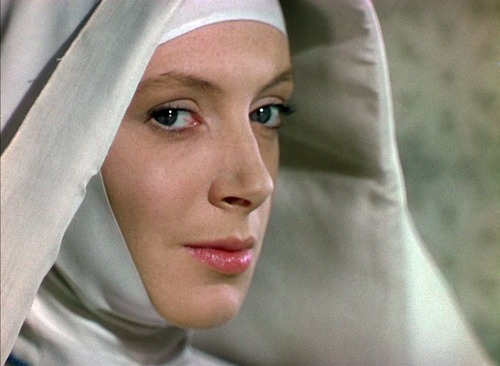 |
| Deborah Kerr as Sister Clodagh. |
Jane Murray Flutter informed an attentive audience that the
film was made at Pinewood Studios with only the odd excursion to the home of an
Indian army retiree at Leonardslee in West Sussex to film some of the garden
scenes as the property had some authentic plants and trees. The look of the
film was down to the cinematography of Jack Cardiff, whose was acknowledged by
an Academy Award and a Golden Globe, it was also the first Technicolor film
after the second World War. Ms Murray
Flutter went on to tell us that her mother was born in Sussex in 1907 and in
1908 she was taken with her three sisters to live and grow up in a part of
India that is now Bangladesh. When Rumer Godden and her sisters were old enough
they were sent back to England for their education, eventually Rumer trained as
a dancer and returned to her beloved India setting up a mixed race dance school
that was certainly not popular with the British Raj.
 |
| Kathleen Byron as Sister Ruth. |
The idea for Black
Narcissus came to the authoress when she was trekking in the Himalayas and
she came across a simple wooden cross with the inscription ‘Sister RIP’ an incident
from which came a best selling novel that is still in print some 74 years
later. Our speaker told us that her
mother did not like Power and Pressburger’s adaptation of her work because in
her opinion the film was too gimmicky and did not ring true to its source. But it
was not the case with other novels that had been adapted including The River (1949), which was the first
major film to be made on location when it was shoot entirely in India with the
rushes being sent back to Pinewood to be developed. Jean Renoir directed it
with Godden writing the scene play. Another feature film for which she wrote
the screenplay was The Greengage Summer
(1956) starring Susannah York and Kenneth More, filmed in the Marne region of
France.
 |
| A very young Jean Simmons. |
Another memorable evening for the RBC with Jane Flutter
Murray rounding off by agreeing with Alec Barclay’s comment that this new
digital print of Black Narcissus was extremely
clear with very little faded colour tone and she pointed out that it was the
first time she had had the pleasure of seeing the new copy. Thanks to Ms
Flutter Murray for a very interesting evening and thanks to Tom Benson for
hosting the proceedings. The new season of RBC Film Club starts on the 19th
November 2012.
 |
| Another successful evening at the RBC as captured by Alec Barclay. |


