Monday, 22 December 2014

Mr Turner.


One of the most important elements of any movie is its stories characters and how they are drawn and presented to us on the screen. Mike Leigh is a past master in converting actor’s lines to a totally believable portrayal of their personalities.  Leigh’s films over the years have given us people like Poppy Cross in Happy Go Lucky (2008), Mary in Another Year (2010), Maurice and Cynthia Purley in the award winning Secrets & Lies (1996) and many more besides. But it’s not just the main characters that are finely illustrated but also the minor one’s. This is one of the noticeable qualities of the British director and writer’s latest movie Mr Turner (2014).
 
The artist.
If anything the characters in this biographical period drama are as good as anything that Leigh has done in the past. Firstly we have William ‘Billy’ Turner (Timothy Spall) an artist who painted rather drab seascapes in the 19th century, had two mistresses, the first of which, Sarah Danby (Ruth Sheen), bore him two daughters, which he is said to have denied. His second mistress Sophia Caroline Booth (Marion Bailey) who he shared a house in Cheyne Walk, Chelsea as ‘Mr Booth’ for 18 years and where he uttered his dying words “The sun is God” Both these women are totally different with Sarah the hard faced women who felt very wronged by Billy Turner, where as the twice widowed Sophia was in love with him.
 
'Mr Booth' with Sophia.

The two William Turners.

Two other characters are worth mentioning, Turner faithful housekeeper Hannah Danby (Dorothy Atkinson), who was devoted to her master, although he sexually abused her, and who suffered from the skin disease psoriasis. The other is Turners father, also called William (Paul Jesson) who had lived with and helped his son for 30 years since the death of his wife at a young age locked away in an insane asylum. It was this mans death in 1829 that had a profound effect on the painter who was getting ever more eccentric and also beginning to suffer bouts of depression. It’s these two characters that light up the screen every time they appear, and I can’t help feeling that the film looses something after the death of William Snr?   
 
The faithful housekeeper.

We could be watching an adaptation of a Charles Dickens novel, the writing is that good. Along with the award winning performance of Timothy Spall, the cinematography of Dick Pope, who captures the vivid light and colour of so many of the scenes that would end up on the artistes canvas and who has worked along side Leigh on many of his movies, and the unique detail’s that make this movie head and shoulders above other period dramas and as importantly brings the 19th century world of art, culture and promiscuity to life.    


Friday, 19 December 2014

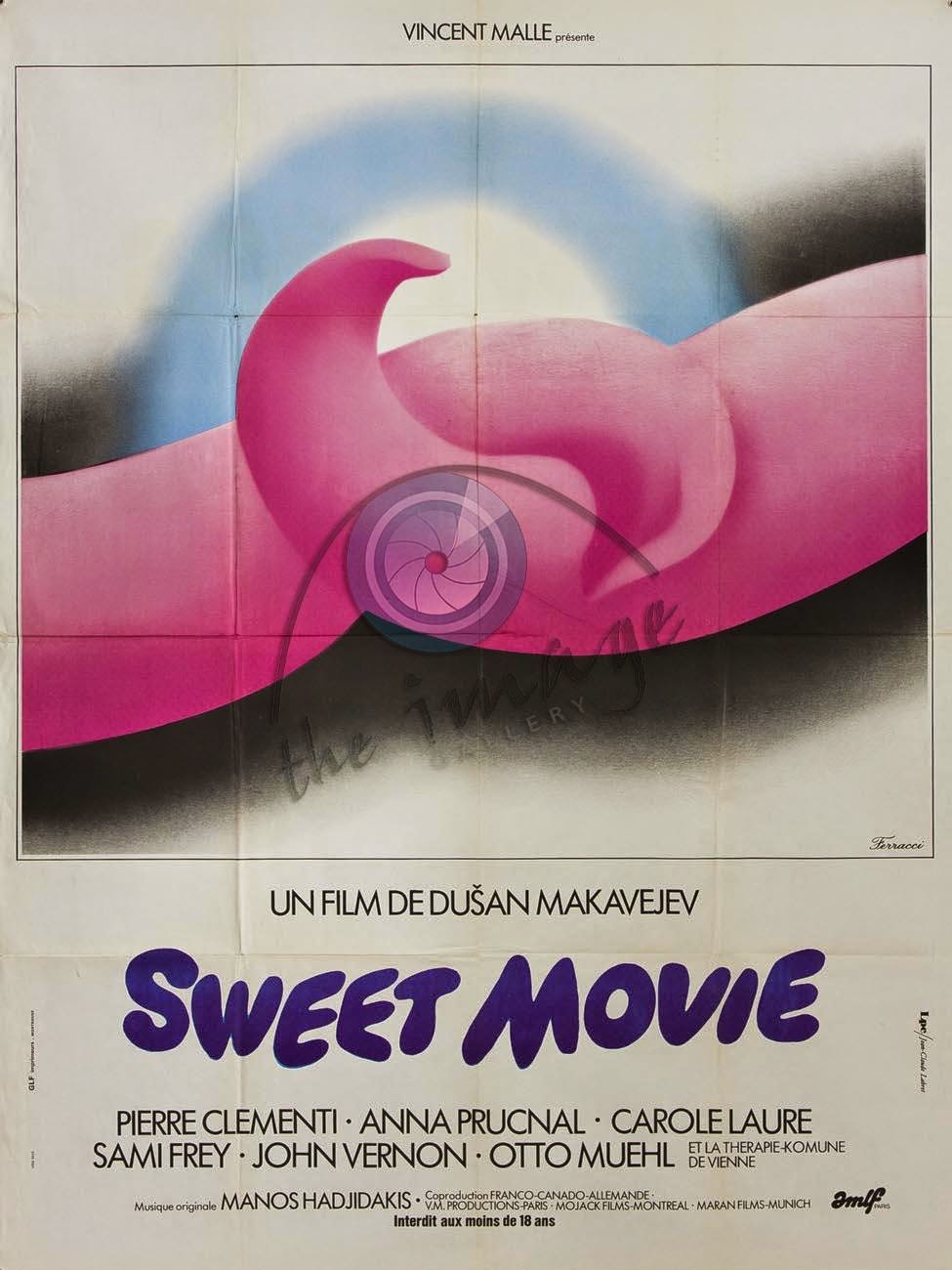
Sweet Movie


How do you start to describe Dusan Makavejev’s 1974 avant-garde art house comedy drama Sweet Movie? The simplest way would be to say that the movie concerns two very different women, a Canadian beauty queen known as Miss World 1984, who represents the destructive force of American consumerism, and Anna Planeto a captain aboard a ship laden with sweets and sugar who represents revolution, but that would be too simplistic. A better description could probable be an anarchic look at sexual repression, communism and economics?

The film ‘is carnivalesque with vengeance, aimed at overthrowing every arbitrary rule, regulation and tradition it can find, including the conventions of cinema itself’[1] and Makavejev succeeds with plenty to spare! Since its release the movie has been described as uncouth, uncivilised, and offensive and has been banned, or severely cut in many countries. A film guaranteed to course lively debate whenever and wherever it’s shown.

Makavejev was forced to move from Yugoslavia to Europe following his political satire WR: Mysteries of the Organism (1971) to allow him to continue to make films, but still finance, even in Europe, was difficult to come by, but he managed to raise the funding for Sweet Movie from Canada, the Netherlands and France as well as Sweden and West Germany.  
 
Anna Prucnal.
There were even more serious consequences for Polish actress Anna Prucnal who plays Captain Anna. The Polish authorities deemed the film to be pornographic and anti-Communist and took away the actresses passport exiling her from her homeland for seven years, not even granting her a visa to visit the country when her mother passed away!

For chocolate lovers only!
The narrative for Sweet Movie, which like WR: is allegedly based on the theories of sexually liberation put forward by psychologist Wilhelm Reich, starts with the Crazy Daisy Show introduced by the Director General of the Chastity Belt Foundation (Jane Mallet) who is running a competition to find the prettiest virgin for Miss World 1984. Her prize is marriage to Mr Dollars (John Vernon) the world’s wealthiest man. But when the new bride (Carole Laure) discovers that her husband has a gold plated penis and a ‘morbid fear of sex related disease’ she rejects him. In response the family bodyguard takes her to the giant milk bottle on the roof of Mr Dollars milk emporium, sexually humiliates her, packs her in a suitcase and sends her to Paris. Waking up on the Eiffel Tower she has intercourse with a Latin singer, ending up in hospital when the pair cannot be separated! Miss World 1984 goes on to join the Therapy Commune of Otto Muehi who performs exaggerated bodily functions. She takes part in a meal, which includes vomiting the food you have just eaten followed by one of its members performing regression therapy, a rebirth experience where he cries, urinates and defecates over himself. The group then clean, powder and pamper him. We finally see Miss World 1984 take part in the filming of an advert for chocolate in which she totally immerses her naked self.
 
Survival on the canals of Amsterdam. 
Meanwhile in Amsterdam Captain Anna’s boat Survival, with the enormous head of Karl Marx on its bow, sails on the canals of the great city with its cargo of sweets and sugar. She picks up a young sailor from the Potemkin (Pierre Clementi) who professes his love, but she warns him that she kills all her lovers, excepting this condition he moves onto the boat and the pair begin their lovemaking on a large suspended vat full of sugar. Also invited onto the boat are a group of pre-pubescent boys who she seduces. (It’s this scene that got the film banned from the UK)
 
Lovers beware?
Is there life after birth? A fantasy sure enough but one that’s rich in political references, not always recognised by viewers from the west admittedly, and phallic symbols, mainly penises including the Eiffel Tower – intellectual cinema about ideas and multi-layered references. The film is interwoven with documentary clips including some disturbing footage from a German film showing the victim’s of the Katyn Massacre when the Russian Army executed Officers from the Polish army, a brave move by the director for 1974 considering we were still in the midst of the cold war. 
 
Carole Laure.
Dusan Makavejev was part of the Yugoslav Black Wave a movement of the 1960’s and early 1970’s that was known for its non-traditional approach to filmmaking, which included black humour and a critical examination of the Yugoslavian society. Director of photography is Pierre Lhomme. The film's music is composed by Greek composer Manos Hadjidakis.


[1] David Sterritt – Wake Up.

Thursday, 18 December 2014

Stations of the Cross.


Written by siblings Dietrich and Anna Bruggemann, with Dietrich in the director’s chair, Stations of the Cross (2014) deals with extreme catholic fanaticism channelled through the eyes of a pretty 14-year-old schoolgirl Maria Gottler (an excellent Lea van Acken). She is preparing for her confirmation in to the Society of St Paul, inducted into its ways by her priest Pater Weber and her piously repressed mother (Franziska Weisz). But I’m afraid that this story is far removed from the Sunday service and Biblical teachings we learnt at Sunday school! The scene is set in the first ‘station’ when we discover the Priest brainwashing a group of youngsters, including Maria, sitting around a table that is meant to bring to mind The Last Supper. He pontificates about the dangers of satanic music, movies, social media and unbelievable, cake! Maria’s home life is fraught with repression and guilt; her personnel guilt is bound up with her younger brother who cannot speak.


Indoctrinated by both the Church and at home....


A disturbingly harrowing, but moving look at what could have been a perfectly normal childhood albeit for her exposure to the pressured religious bigotry which denies her not only the natural life of a ordinary teenager but also her emerging sexuality. This very well made and shot film is literally divided up into the 14 stations Christ passed through on the way to Calvary, each depicting a different part of his martyrdom. An austere movie with a complete lack of humour, is it a sin to laugh?  After watching this you will be convinced it probably is! It confounds the view that extreme religion can be found in many different parts of the world and is not confined to the Middle Eastern countries as our media would have us believe!

....forces Maria to punish herself unnecessarily!

Wednesday, 17 December 2014

The Good Die Young.


I have previously mentioned British film director Lewis Gilbert when writing about Cast A Dark Shadow (1955), which you will remember, starred Dirk Bogarde and Margaret Lockwood. Gilbert’s best known films includes Alfie (1966) which was adapted from a Bill Naughton's play and starred Michael Caine as the sixties icon. Later work included Educating Rita in 1983, which again featured Caine, Shirley Valentine (1989) and three James Bond films; You Only Live Twice (1967), The Spy Who Loved Me (1977) and Moonraker (1979).

Another of the 40 plus films he directed was the British noir crime thriller The Good Die Young (1954) jointly adapted for the screen by Gilbert and Vernon Harris based on a novel of the same name by Richard Macaulay. Filmed mainly at the Shepperton Studios with the climax filmed at Heathrow Airport. It included an American/Canadian/British cast.
 
Four men 'up to no good'.
The film opens with four men sitting in a large saloon car clearly up to no good, (the men not the car) something that’s reinforced when handguns are handed out. These four men, two British and two American, have apparently only known each other for four weeks. The spoken narrative informs us that they all have clean criminal records; it then goes on to explain how each of these very different individuals came to be sitting in the car.

Joe Halsey (Richard Basehart) a clerk has flown to Britain to find out why his wife Mary (a twenty year old Joan Collins) has not returned from a two weeks holiday in the UK where she went to look after her mother who had been ill.  Mary’s mother (Freda Jackson) is insecure and noticeably unstable and does not approve of Joe and wants nothing more than to keep her daughter in the UK and split the couple up. But Joe who finds out his pretty young wife is pregnant wants to return to New York with her as soon as he can get the plane fare together.
 
Each man needs an injection of money to solve his immediate problems!
Mike Morgan (the ever dependable Stanley Baker) an ex-navy man who realises he has come to the end of his relatively unsuccessful career as a boxer and needs just one more fight to increase his total savings to £1000 which he believes is enough money for him to retire and live happily ever after with his caring wife Angela (Rene Ray). But Angela has a younger brother who is forever on the wrong side of the law. When his sister puts up to bail money for his release he skips the country and Mike and Angela loose all their savings.  Even if he wanted too, Mike couldn’t go back in the ring because following an accident his hand was amputated, in fact Mike is finding it imposable to find any kind of employment.

Eddie Blaine (John Ireland) is an American air force Sargent who is about to be transferred from his base in the UK to one in Germany, but the fly in the ointment is his unfaithful actress wife Denise (the sultry femme fatale Gloria Grahame) who will not go with him because of her career, but Eddie suspects that its more to do with her leading man Tod Maslin (Lee Patterson). Eddie goes AWOL and needs to get away from both the UK and his unfaithful wife.
 
Problems are not always of your own making.
Miles ‘Rave’ Ravenscroft (Laurence Harvey) has a very rich father and a very rich and sophisticated wife Eve (Harvey’s wife to-be Margaret Leighton). But Rave indulges in extramarital affairs and sponges off his wife to pay his gambling debts. But Eve refuses to settle up his latest liability that is owed to a rather unscrupulous villain who will stop at nothing to get his money. Even his father will not cough up the required dosh.  Rave needs to raise some money - quickly.   


This atmospheric suspense drama boasts a very cleverly constructed story that gradually unravels as the film progresses and manages to keep a tight grip on your attention span for its 94 minute running time. In my opinion it benefits from changing the novels original location from America to 1950’s England where it’s made obvious that the four main characters are still reeling from the end of WW2.  It’s not just the main personalities involved in this drama that are extremely well cast but also the rest of the company, who fit their roles like a well tailored pair of gloves. These include Susan Shaw, Robert Morley and Leslie Dwyer.