Tuesday, 16 December 2014

Salvo.


We first meet Salvo, a Mafia Hitman, during a 40c heat wave in Palermo as his boss Randisi is driving him to his latest assignment.  The car comes under attack in a very well planed ambush. Salvo goes after the attackers killing one but capturing a second who is forced to tell who set up the ambush before being executed. There’s a debt to settle and Salvo is sent to extract vengeance on Renato Pizzuto. When the hit man arrives at the much-feared rival’s house he only finds his blind sister Rita at home. Holding her captive until Pizzuto returns when he is able to complete his task. But for some reason he is unable to bring himself to kill the dead mans sister, instead he spares her life and takes her to a disused industrial estate and locks her up. But by lying to his boss, he tells him he has killed both siblings, he sets up an unexpected chain of events.
 
The mafia hitman Salvo.

The very brave Rita.


Directors Fabio Grasadonia and Antonio Piazza, who also wrote the story, present us with a movie that is slow paced, with very little dialog but this does not detract from your enjoyment of this meaningful film. Basically it’s a tale of two very different human beings. Salvo, whose strong physical presence is brilliantly portrayed by the Palestinian actor Saleh Bakri, is a character that say’s very little, a hard man whom never smiles and kills without a second thought. The directors/writers admit taking their inspiration for this individual from Jean-Pierre Melville Le Samourai starring Alain Delon. Another influence was the Spaghetti Western that can be easily spotted in the showdown in the industrial estate.  The dancer Sara Serraiocco, in her first feature film, plays the blind Rita with exceptional believability and as I said in my review for the UK Premiere for Greyhawk (2013) it’s never easy for an able sighted person to convincingly play a blind character.  Topping off this highly recommended film is the cinematography of Daniele Cipri whose camera angles give the film a certain unique style of its own.

Friday, 12 December 2014

The Silent Army (Wit Light)


I think at best Dutch film director and screenwriter Jean van de Velde’s 2008 movie The Silent Army, or to give it its Dutch title Wit Light, is commendable in that it raises awareness, which in it self is never a bad thing, about a situation that we probable no very little about. But in this case it’s the story that’s a little far fetched, but not of course the problem it highlights, in this case the problem with and the hardships of child soldiers in Africa. Admittedly not the first film to be made about the subject, Johnny Mad Dog a French/Liberian film directed by Jean-Stephane Savaire was also released in 2008.
 
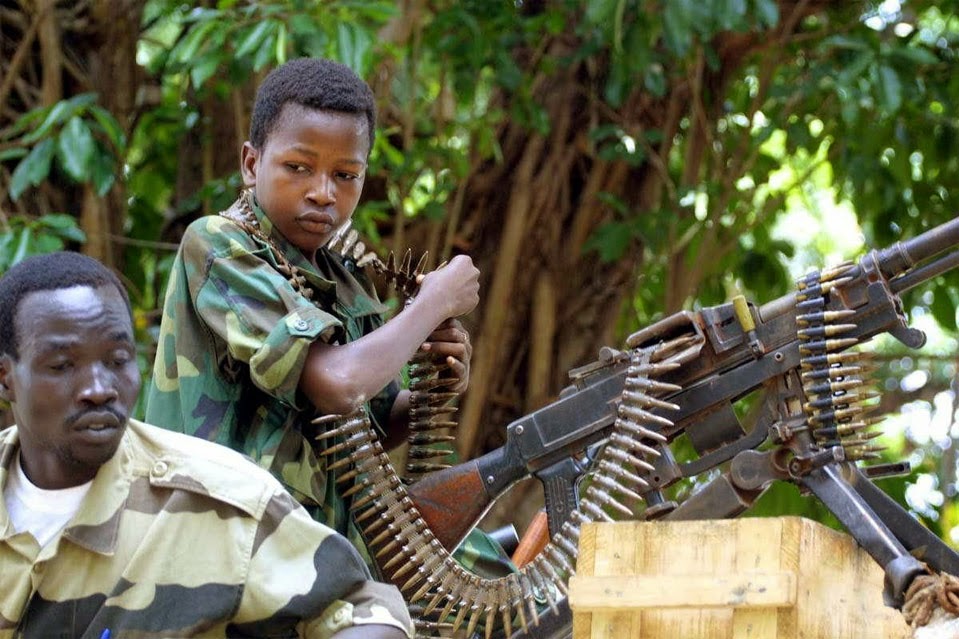
Small boy - big gun!
Dutchman Eduard Zuiderwijk owns and runs a restaurant conveniently located close to a conflict area involved in a civil war. When his wife (Ricky Koole) is killed in a car crash he is left to bring up his nine-year-old son Thomas (Siebe Schoneveld). Thomas’s best friend is a wee African boy whose mother works in the restaurant, but when rebels raid the village they live in Abu (Andrew Kintu) if forced to hack his crippled father to death with a machete. He is then abducted and taken to join the army of the rebel leader, a vicious psychopath, Michel Obeke (Abby Mukiibi Nkaage) to be trained as a child soldier. The rather naïve Thomas tries to persuades his father to search out the abducted boy and rescue him. Eduard, who you think would no better, closes the restaurant and takes his son on an ‘unarmed’ car journey to find the missing boy.  
 
Africa's Child Army.
What spoils the film for me is the character of Eduard Zuiderwijk whose actions and story line are extremely far fetched. Going off into the wild and dangerous countryside where no one dares to go "without an army" with a nine-year-old child in tow to find another child who, along with all the other members of the child army, has been completely brainwashed in to killing anyone that Obeke, now known as ‘daddy’, instructs them too!  Into all this bedlam is injected a love interest for Eduard in the form of the blonde good-looking NGO[1] worker Valerie (Thekla Reuten) who along with a rather dubious looking photojournalist (Peter van den Begin) do actually try to talk the restaurateur out of his highly perilous rescue mission into rebel territory, but surprise surprise, to no avail.   
 
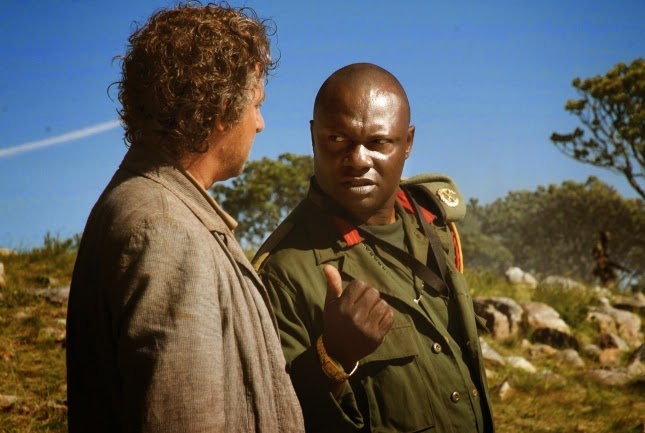
Eduard Zuiderwijk meets 'Daddy'. 
Marco Borsato, in his debut role, play’s Eduard Zuiderwijk.  Borsato, who is one of the most successful and biggest grossing musical artists in the Netherlands and has been so for the past twenty years, is an ambassador of the Dutch NGO War Child, which helps children in (post) conflict areas to cope with their war experiences. By all means have a look at the film because I think it was made with the best of intentions but I’m afraid it did not succeed.


[1] Non-Governmental Organization.

Thursday, 11 December 2014

The Hobbit. The Desolation of Smaug.


I really didn’t expect to watch the second part of Peter Jackson’s trilogy but getting a loan of a copy of the Blu-ray rather forced my hand. But I’m afraid to say that I still had the same problem with the penultimate movie as I had had with the first. The problem really  is obvious, the dragging out of such a small novel of well under 300 pages to fit a movie timescale of over eight hours and still make it interesting has not succeeded and although The Hobbit. The Desolation of Smaug (2013) is not as boring or mind numbing as An Unexpected Journey (2012) it still plodded along somewhat tediously with many of the scenes going on far to long. And ladies and gentlemen there is still another 144minutes to go! Don’t get me wrong its a fine story and one that could have been fitted into a single film, think of the excitement that would be generated, it has a fine cast, miraculously shrunken down in size to play all the height disadvantaged people. My best advice, that I should have taken, would be to give Mr Jackson’s trilogy a miss – unless you suffer from insomnia.

Wednesday, 10 December 2014

The Overnighters.


There are nights at the Robert Burns Centre Film Theatre Dumfries when the talk or the question and answer session following a films screening is more interesting than the film itself.  It happened again after the Film Club screening of the American documentary The Overnighters (2014). Let me explain, the RBC had arranged for a local representative of Shelter Scotland to give us a post-film talk on homelessness in Dumfries because the subject matter of Jesse Moss’s film was to do with homelessness in and around the oil boom taking place in North Dakota located in the Upper Midwestern region of the United States of America. But it turned out that the problems Shelter deal with are far wider ranging than these seen in the documentary.
 
Man travel from allover the US for the prospect of work.
Moss was not only the director but also the writer and producer, as Ellen Mitchell told us in her introduction to the documentary, and has six previous documentary’s as director to his credit.  She also said that his latest work has been described as ‘painfully relevant’ and ‘hard hitting’.
 
The Pastor preaches to his "new" congregation.

The men are introduced to their new sleeping quarters. 

The film is set in Williston, which is enjoying a boom in the oil industry. The local population are beginning to imagine that all the unemployed men in America are descending on the town in search of employment. But the reality is that these men are chasing the broken American dream we all keep hearing about and Williston is no different. There are in fact slim pickings as far as work prospects go and an even bigger problem for both employed and unemployed is that there is quite simple no where to sleep. Pastor Jay Reinke of the Concordia Lutheran Church comes to the rescue and arranges for the migrants to bed down on the floor of the church much to the disgust of not only the Pastors congregation but also to the wider public of this small introverted community. He also opens up the church car park allowing them to sleep in their cars and RV’s. The situation becomes even more heated when it’s revealed that a lot of the men staying under the protection of Reinke have chequered pasts. Some have served prison sentences while others are on the sex offender’s register! Gradually the pressure mounts and the Pastor begins to come to the realisation that this refuge for his fellow human beings may have to be closed down.
 
Things get a bit too much for Pastor Jay. 
Described in the press notes as “A modern-day Grapes of Wrath, The Overnighters engages and dramatizes a set of universal societal and economic themes: the promise and limits of re-invention, redemption and compassion, as well as the tension between the moral imperative to “love thy neighbour” and the resistance that one small community feels when confronted by a surging river of desperate, job-seeking strangers[1]. As commendable as the film is, by the end, and I won’t give away a wee twist in the last ten minutes, you’re not really sure whether the documentary is about the endemic problem of unemployment and the lack of descent affordable accommodation amongst people whose rights are decidedly limited by their social standing or is it the story of a humanitarian’s downfall? Either way is a difficult situation and you will just have to go and see the documentary and make your own mind’s up.


As I have said previously, the screening was followed by a talk from Victoria Long who works for Shelter Scotland as a Family Support Worker based in Dumfries and Galloway (D&G). She started by telling us a little of the registered charity’s history. Shelter was launched on 1st December1966 encouraged by the outcry that was raised after the showing of the BBC’s Wednesday Play Cathy Come Home written by Jeremy Sandford, directed by Ken Loach[2] and starring Carol White and Ray Brooks. The play highlighted the plight of a family, including their two young children, who fell on hard times and eventually were made homeless. After seeing the play, social campaigner and political activist Des Wilson helped to set up Shelter.
 
The well known charity shop in Dumfries High Street.
Victoria went on the explain that in D&G, Dumfries and Annan are the most problematic area’s and with a 1000 to 1200 increase each year over the last five years and with Westminster changing the benefit rules homelessness can only get worse. Because of the ‘bedroom tax’ single people cannot afford to stay in two-bedroom accommodation any longer and the stock of cheap one-bedroom flats is almost non-existent.  Couple this with the fact that the Government no longer pay private landlord’s their rent direct (Universal Credit gathers together six means tested benefits and tax credits including housing benefit and pays the claimant once a month), rents are sky high and if you make a mistake whilst making a claim for job seekers allowance your ‘sanctioned’ which means you get no money for a minimum period of four weeks and up to a maximum of three years! The authorities have 28 days to investigate so you’re going to be without means of support for some time. Lack of employment opportunities in the area does not help the situation either.
 
Is this the right place for an solider? 
Shelter Dumfries, supports both single people and families, people with drug and alcohol problems and domestic abuse victims. Two teams work in the D&G area; one deals with families the other with single people. The local council, who also provide housing and funding, refers clients to Shelter. 


Campaigns to raise awareness and funds.

Working along side other support services Shelters work includes many other aspects related to helping people, mainly male, with problems including rent and mortgage arrears, landlord disputes, eviction and repossession, damp and dangerous housing, overcrowding and general legalities in regard to housing rights. Shelter believes that everyone should have a decent home, warm and safe, it’s a pity that our lords and masters don’t believe the same! They also advice people on how to manage their finances and any legal problems they may have in connection with their accommodation.  All their work does not just involve people of working age but also older folk who have lived in tied housing as part of their employment and now they have reached retirement age have nowhere to live. There was also something Victoria said that particular raised my hackles where as families turn out their own children? How the hell can you sink so low that your prepared to make your own kids homeless!!
 
This is someone's son!
This was a very informative introduction to the work of Shelter Dumfries and I for one would like to thank Victoria Long for sacrificing her free time to come along to the RBC on a cold Monday night. It’s just a shame that more people were not there to benefit from it. We are all aware that our system of government is based on exploitation and greed and does not really care about the ordinary working class person, but unless our governmental system is changed completely the poor will continue to be exploited for profit and never get a fair crack of the whip. Organisations like Shelter and the Food Banks will be ever more stretched; eventually with the cutbacks we are promised they will probably get to a stage when they are unable to cope at all. Then what?

 
The despair of people living on the streets in one of the richest countries in the world!


[1] Overnighters Press Kit.
[2] Ken Loach has said that despite the public outcry following the play, it had little practical effect in reducing homelessness, other than changing rules so that homeless fathers could stay with their wives and children in hostels.

Tuesday, 9 December 2014

A Touch of Sin.


You don’t imagine that modern China is quite as violent as it is portrayed in Jia Zhangke latest movie, but as it’s based on four different real life incidents, one is forced to take the directors word for it. These incidents include three murders and a suicide and are well known to the people of China.  The events happened in four different rural areas of the country, Shanxi, Chongqing, Hubei and Guangdong. Zhangke has been quoted as saying that he wanted to use news and Weibo (China’s equivalent to Twitter) reports to build a comprehensive portrait of life in contemporary China. And although the country appears far more prosperous than it did in the past, many of the inhabitants face personal problems because of the uneven spread of wealth across the country and like most other countries in the world large disparities exist between the rich and poor. He goes on to tell us that individual people can be stripped of their dignity at any time and because of this, violence is increasing and it is clear that this is the only way that the weak and underprivileged can restore their lost dignity.
 
Industrial relations are not good for the miner Dahai.
The film opens with Zhou San (Baoqiang Wang), the subject of the second story, being stopped on deserted highway by three axe wielding young men who try to rob him, Zhou pulls out a firearm from his jacket and shoots and kills all three. This incident is indicative of the violence that is to follow.  The first story proper involves Dahai (Jiang Wu) a disillusioned miner who is enraged by widespread corruption in his village and decides, being a good citizen, to dispense justice the only way he knows how. In the second story we again meet the motorcyclist Zhou San who we discover is on his way to celebrate his mothers 70th birthday celebrations along with his two brothers, his estranged wife and their wee son. We discover in no uncertain terms why Zhou carries a gun and how he earns his living!
 
Theres a surprise in Zhou's jacket for someone. 
In the penultimate tale a young receptionist Xiao Yu (Tao Zhao), in love with a married man and wants him to leave his wife, works at a local ‘sex sauna’ and has a unique way of dealing with abusive customers. The final story involves Xiao Hui (Lanshan Luo) a teenage factory worker who goes from one depressing job to the next with increasing demands from his mother to send more and more of his low wages, and when his circumstance deteriorate further he decides to carry out a rather finalistic approach to his problems.
 
Xiao Yu has a unigue way of dealing with abusive customers. 
Jia Zhangke wrote and directed a rather daring and brave film that does not really condemn violence but does condemn the fact that neoliberalism has taken over from communism in an expanding China.  Shot mainly on location and in the Datong Studio’s in Shanxi, the film was originally due for release in China in November 2013, but although the Film Bureau passed the film it still has not been released officially. The authorities were alleged to be worried that the movie would encourage social unrest. A pirated copy of the film was circulated on the Internet and over 30000 Chinese have already posted comments on the movie!